USAID
Etude sur la Volonté de Payer en Côte d'Ivoire
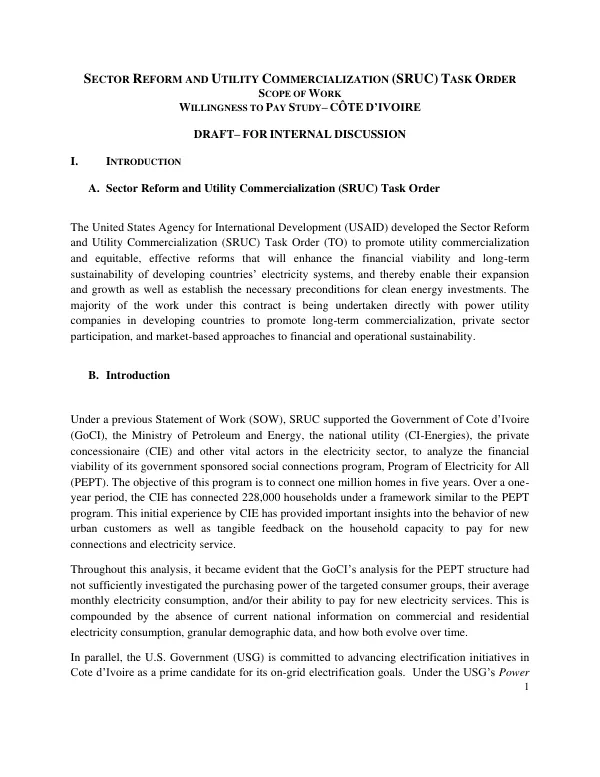
The study on willingness to pay in Cote d'Ivoire, conducted by the Sector Reform and Utility Commercialization (SRUC) team, began on February 13, 2019.
2019 · 82 pages
Sign in to readA free account is required to download.
Abstract
The primary objective of the study is to measure the willingness to pay (VDP) of consumers for electricity services. The VDP can be measured in two ways: expressed or revealed. The expressed VDP is determined by directly asking consumers a specific amount in CFA that represents their willingness to pay for a given quality of electricity service. This method is subjective and relies on the respondent's ability to imagine a hypothetical scenario and estimate a value that reflects their willingness to pay. The expressed VDP is often used to capture the value that consumers place on improved electricity services, such as reliable electricity available 24 hours a day. On the other hand, the revealed VDP is determined by aggregating the actual expenses of consumers for electricity services connected to the grid or alternative energy sources. This method is considered more reliable as it is based on historical expenses related to electricity services. However, it may underestimate the value associated with improved electricity services, as prices reflect the value of current service levels, which are likely to be lower. The choice of method depends on the study's objectives and the specific context of the study. The revealed VDP is often used as a basis for project feasibility and financial projections, as it provides a more objective measure of consumer willingness to pay. In contrast, the expressed VDP is more subjective and may be influenced by biases, such as respondents providing a "protest response" to receive a lower price or overestimating their ability to pay due to enthusiasm for improved electricity services. The study highlights the potential methodological lacunae associated with both the expressed and revealed VDP methods. The expressed VDP may lead to biases, such as respondents providing a lower willingness to pay in the hope of receiving a lower price or overestimating their ability to pay due to enthusiasm for improved electricity services. In contrast, the revealed VDP may underestimate the value associated with improved electricity services, as prices reflect the value of current service levels. The study's findings have implications for the design of electricity services and the pricing of these services. By understanding the willingness to pay of consumers, policymakers and utility companies can design services that meet the needs and preferences of consumers, while also ensuring that these services are financially sustainable.