USAID DEC
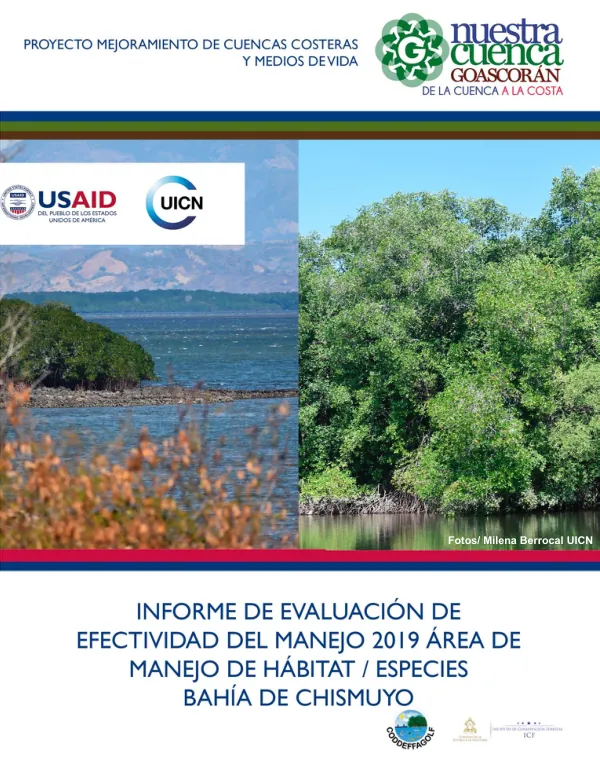
Evaluación de Monitoreo de la Efectividad de Manejo del Proyecto Mejoramiento de Cuencas Costeras y Medios de Vida en Bahía de Chismuyo
Sign inUSAID DEC
Evaluación de Monitoreo de la Efectividad de Manejo del Proyecto Mejoramiento de Cuencas Costeras y Medios de Vida en Bahía de Chismuyo
The project Mejoramiento de Cuencas Costeras y Medios de Vida, developed by the Unión Internacional para la Conservación de la Naturaleza (UICN), aimed to promote the integrated management of coastal watersheds through the protection of ecosystem services and biodiversity, sustainable livelihoods for communities, local practices for climate change adaptation, and participatory water governance at all levels.
2019 · 46 pages
Sign in to readA free account is required to download.
Abstract
The project was funded by the United States Agency for International Development (USAID) and implemented by the UICN in collaboration with the Comité para la Defensa y Desarrollo de la Flora y Fauna del Golfo de Fonseca (CODDEFFAGOLF) and the Instituto Nacional de Conservación y Desarrollo Forestal, Áreas Protegidas y Vida Silvestre (ICF) Región Forestal del Pacífico. The project focused on the Bahía de Chismuyo area, which is a protected area managed by the UICN and CODDEFFAGOLF. The evaluation of the effectiveness of management (EEM) was conducted to assess the project's impact on the social, administrative, natural and cultural, and economic-financial aspects of the area. The evaluation involved the participation of various stakeholders, including local communities, government agencies, and NGOs. The EEM methodology consisted of a conceptual framework, which included a plan for the evaluation process, participants, and a program of workshops. The evaluation indicators were categorized by management area, and a scale of valuation was applied to assess the results. The evaluation results showed improvements in the social, administrative, and economic-financial aspects of the area, but also identified challenges and areas for improvement. The social aspect of the evaluation showed that the project had a positive impact on the local communities, with improvements in education, health, and livelihoods. The administrative aspect of the evaluation showed that the project had improved the management of the protected area, with increased participation of local communities and government agencies. The natural and cultural aspect of the evaluation showed that the project had improved the conservation of the area's biodiversity and cultural heritage. The economic-financial aspect of the evaluation showed that the project had improved the economic benefits of the area, with increased income and employment opportunities for local communities. The co-management aspect of the evaluation showed that the project had improved the collaboration between local communities, government agencies, and NGOs in the management of the protected area. The evaluation concluded that the project had been successful in achieving its objectives and had a positive impact on the social, administrative, natural and cultural, and economic-financial aspects of the area. The evaluation also identified areas for improvement and recommended that the project continue to support the local communities and government agencies in the management of the protected area. The project's results were presented in a series of tables and graphs, which showed the evaluation results by management area and the comparison of indicators over time. The evaluation also included a summary of the results and a set of recommendations for future action. The project's findings and recommendations were presented to the stakeholders, including local communities, government agencies, and NGOs, and were used to inform future decision-making and planning. The project's methodology and results were documented in a series of reports and publications, which were made available to the stakeholders and the public. The project's findings and recommendations were also presented at national and international conferences and workshops, and were used to inform future research and policy development. The project's impact on the social, administrative, natural and cultural, and economic-financial aspects of the area was significant, and the evaluation results showed that the project had been successful in achieving its objectives. The project's methodology and results provided valuable insights into the effectiveness of the project and identified areas for improvement, which will inform future decision-making and planning.