USAID DEC
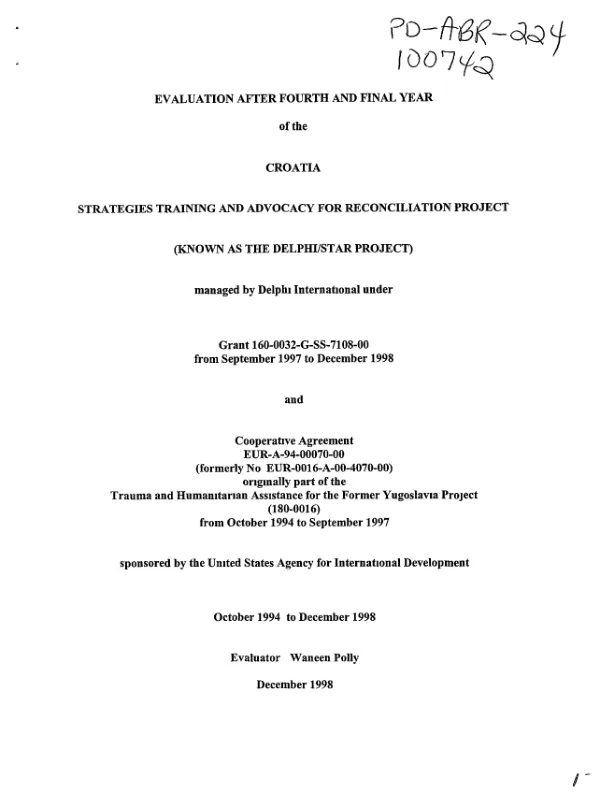
Evaluation after fourth and final year of the Bosnia-Herzegovina strategies, training and advocacy for reconciliation project (known as the Delphi/STAR project) managed by Delphi International under cooperative agreement no. EUR-A-94-00070-00 : September 1994 to December 1998
Sign inUSAID. BUR. FOR EUROPE AND THE NEW INDEPENDENT STATES
Evaluation after fourth and final year of the Bosnia-Herzegovina strategies, training and advocacy for reconciliation project (known as the Delphi/STAR project) managed by Delphi International under cooperative agreement no. EUR-A-94-00070-00 : September 1994 to December 1998
Final evaluation of a project (9/94-12/98), part of the Strategies, Training, and Advocacy for Reconciliation (STAR) project, to develop the capacity of women leaders and NGOs in Bosnia-Hercegovina to address issues of concern to women.
Polly, Waneen · 1998
Sign in to readA free account is required to download.
Abstract
The evaluation focused on the final year of the project. Delphi International was the implementing agency. During years 1-3, the project focused on fostering cooperation between groups outside the Zenica-Tuzla-Sarajevo triangle in the Federation and groups in the Republic of Srpska (RS). During year 4, it focused on enhancing linkages among women's groups, creating a core of advocacy-able NGOs and decreasing dependence on the project. The project's unique contribution to the stability of women's NGOs was its initiation of capacity-building activities during the war, thereby giving the NGOs a head start in carrying forward the structural and programmatic transformation required under the new funding conditions of the post-war period. Project provision of targeted, timely, flexible, need-responsive TA, training, and financial support supported the development of a few women's NGOs in both the Federation and RS that were equipped to influence the development of civil society. Project support was important in developing the confidence and skills of many leaders and in stabilizing and animating selected NGOs. Delphi/STAR was more flexible and responsive than other donors in the use of subgrant funds. Two NGO "anchor groups" were funded by subgrants for operations costs; this allowed them to establish themselves and leverage sustaining funds. However, it seems that diminishing donor funds are more likely to support women's NGOs on issues that intersect with the interests of the international community than on the issues that women feel are important, e.g., domestic violence, continued support for victims of trauma, and women's studies. Delphi/STAR's activities on public policy advocacy provided women's NGOs with a critical tool for focusing energy to address the immediate post-war period needs in Bosnia- Hercegovina. While some women, by their nature and propelled by the situation, were carrying out advocacy-type activities, they had not named or systematized their actions. Delphi/STAR helped activists and the women's NGO community to name advocacy as an element of their work. They provided five women with a systematized understanding of key advocacy concepts and encouraged them to develop a localized approach to advocacy through their own work and in the broader NGO community. The project supported NGOs in advocacy actions in their communities through moral support and subgrants. The project investment in advocacy has begun to bear fruit. Women's NGOs are beginning to see that they are able to guide and influence social change. However, the process of developing a critical mass of women and women's NGOs able to collaborate in advocacy efforts has only begun and will have to be furthered if it is to effect broader development of civil society. An outstanding contribution of the project was the development of linkages among women's NGOs across entities and within the Yugoslav Successor States (YSS) through advisory board meetings, issue-oriented exchanges, technical workshops, and meetings. Women used these opportunities to share information, build trust, strengthen relationships, and discuss joint projects and actions. The development of ad hoc coalitions of women for advocacy actions in the areas of women's voter education and domestic violence was a tribute to the linkages among the leaders and the NGOs. Another result was the reduction of fear as witnessed by some Federation women crossing "enemy territory" to attend meetings in the RS. Delphi/STAR's unique and important contributions to the development of women's NGOs and to individual women included: modeling multi-ethnic cooperation and valuing diversity; fostering reconciliation among women; developing organizational capacity during the war; providing encouragement; building programs that were needs-responsive, not donor-driven; strengthening linkages among women's NGOs; providing flexible funding; supporting advocacy development; supporting women, women's development, and women's rights; and supporting publications in local languages. (Author abstract, modified)
Related documents
Documents in this collection
 1998
1998USAID DEC
Evaluation after fourth and final year of the former Yugoslav Republic of Macedonia strategies, training and advocacy for reconciliation project (known as the Delphi/STAR project) managed by Delphi International under cooperative agreement no. EUR-A-94-00070-00 : September 1994 to November 1998
Open record![Delphi International/STAR [strategies, training and advocacy for reconciliation project] Bosnia and Herzegovina : final program report -- January 1-December 31, 1998](https://covers.devme.ai/gen/37432.webp) 1999
1999USAID DEC