USAID DEC
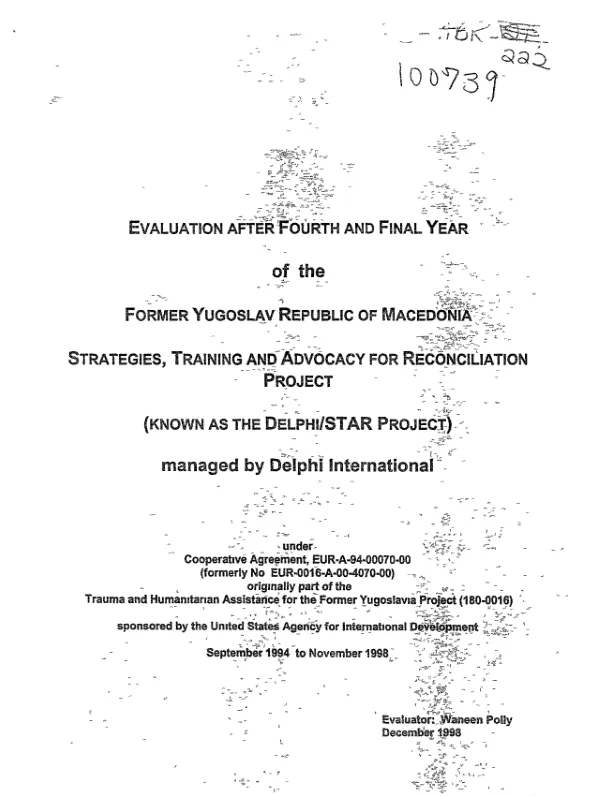
Evaluation after fourth and final year of the former Yugoslav Republic of Macedonia strategies, training and advocacy for reconciliation project (known as the Delphi/STAR project) managed by Delphi International under cooperative agreement no. EUR-A-94-00070-00 : September 1994 to November 1998
Sign inUSAID. MISSION TO MACEDONIA
Evaluation after fourth and final year of the former Yugoslav Republic of Macedonia strategies, training and advocacy for reconciliation project (known as the Delphi/STAR project) managed by Delphi International under cooperative agreement no. EUR-A-94-00070-00 : September 1994 to November 1998
Final evaluation of a project (9/94-11/98), part of the Strategies, Training, and Advocacy for Reconciliation (STAR) project, to develop the capacity of women leaders and young activists in the former Yugoslav Republic of Macedonia, largely outside of Skopje, to address issues of concern to women.
Polly, Waneen · 1998
Sign in to readA free account is required to download.
Abstract
The evaluation focused on the final year of the project. Delphi International was the implementing agency. Delphi/STAR's strategy of focusing on needs identified by the women themselves was appropriate, but the scope of work was not achievable within the project's time frame. When the project ended -- abruptly, due to the failure of a further extension or successor project to materialize -- no partner NGO had graduated, and many loose ends were left. Nonetheless, the project successfully strengthened women's NGOs through excellent facilitation of the subgrant process. While there remain considerable areas for further growth, the distance the women's NGOs have come since the start of the project and in the 15 months since the last evaluation is impressive. The closure of the STAR project left a gap in funding for small grants for women's NGOs. Having worked with Delphi/STAR on projects that addressed needs they had identified, women leaders were reluctant to alter their mission to gain donor funds, and most NGOs are surviving from grant to grant, relying on local sources, including locally based donors and group member volunteerism, for support. On the other hand, the project provided one-to-one support to women's NGOs and the larger NGO community in diversifying funding through private U.S. donors that would otherwise have been unknown to them. This resulted in small grant funding of over $100,000 to 10 groups in the Yugoslav Successor State (YSS) in 1998, nearly one-third to Macedonian NGOs, and over $400,000 in private funds for YSS NGOs over the life of the project. The grants, most of which met their objectives, demonstrated the shift in NGO mission from humanitarian charity to strengthening other women and women's NGOs for social change. The growing reach and influence of several of the NGOs was impressive. In particular, the women from town-based NGOs were uniquely positioned to reach the rural women who are often isolated by traditions which do not allow them freedom of movement and association. While not achieving its lofty goals regarding advocacy, important first steps in developing the advocacy capacity of women's NGOs were taken. A core of women were trained in policy advocacy and have demonstrated skills in taking advocacy actions. Individual NGOs became more visible in their communities and strengthened their public image. Women's NGOs expanded their use of the media. However, the Macedonian women's NGOs will need training, technical support, and mentoring if they are to transform their community education work into successful advocacy. Delphi/STAR enhanced the skills of 16 women leaders and activists in learner-centered training methodologies. Ten of the women, of various ages, major ethnic groups, and different educational levels, worked in multi-ethnic teams and provided a few well-received training workshops for local women and women's NGOs. Some of the women have developed participatory training skills that were both unusual by local standards and needed in the Macedonian context. At the same time, the potential for long-term service as trainers to the women's NGO community was diminished by a lack of time and professional coaching to solidify skills and lack of strategic planning for use of their skills when the Delphi/STAR project closed. An outstanding contribution of the project in Macedonia and the YSS was the consistent creation of environments where multi-ethnic groups could meet, learn about each other, and collaborate on shared issues. As a result, women developed trusting personal relationships and ad hoc collaboration among organizations across ethnic, age, and geographic boundaries that had not previously been possible. USAID should ensure that women's NGOS that are committed to the development of women and civil society have resources targeted to support their work. (Author abstract, modified)
Related documents
Documents in this collection
 1998
1998USAID DEC
Evaluation after fourth and final year of the Bosnia-Herzegovina strategies, training and advocacy for reconciliation project (known as the Delphi/STAR project) managed by Delphi International under cooperative agreement no. EUR-A-94-00070-00 : September 1994 to December 1998
Open record 1998
1998USAID DEC
![Delphi International/STAR [strategies, training and advocacy for reconciliation project] Bosnia and Herzegovina : final program report -- January 1-December 31, 1998](https://covers.devme.ai/gen/37432.webp)