AFRICARE, INC.
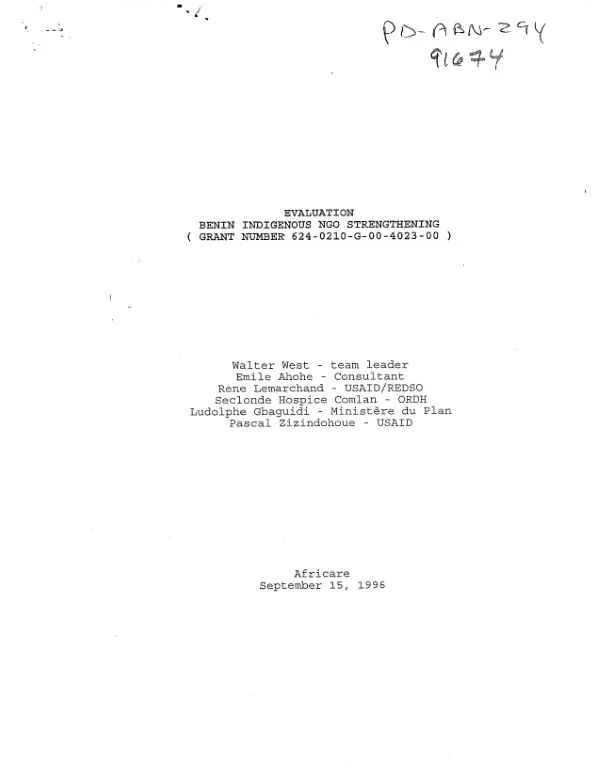
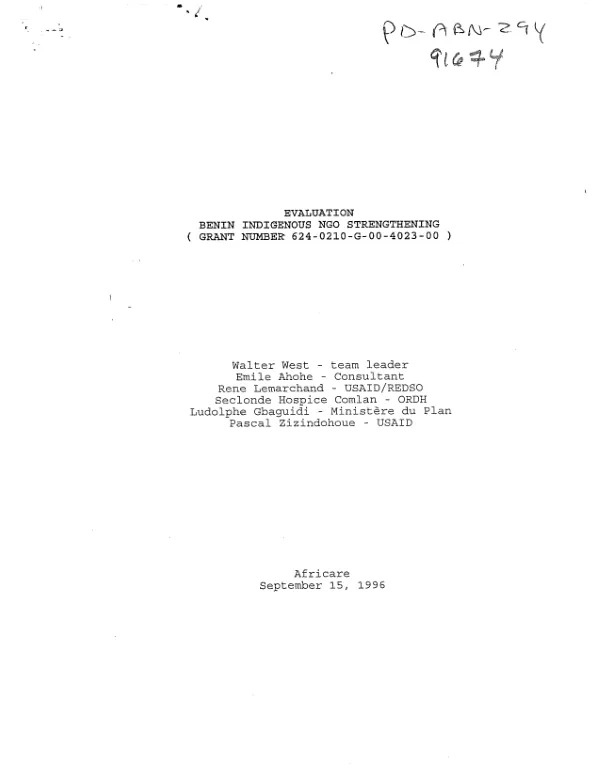
Evaluation : Benin indigenous NGO strengthening (grant no. 624-0210-G-00-4023-00)
Final evaluation of a 3/94 grant to Africare to strengthen indigenous NGOs in Benin (BINGOS project).
West, Walter|Ahohe, Emile · 1996
Sign in to readA free account is required to download.
Abstract
The evaluation, made in 9/96, was held in anticipation of the 2/97 PACD. Of the 33 NGOs accepted into project, 23 remain. By the closure date, the project will have met or exceeded targets for the training and institutional support components. On the down side, beyond sponsoring some exchanges among participating NGOs, BINGOS has not been effective in promoting associations of NGOs or working with federations; the strategy for reaching these complex goals was ill-defined in the project proposal. Additionally, the umbrella grant, the method for promoting NGO linkages, was expensive and lacking in flexibility. If there is a second phase of the project, it should make NGO collaboration an important, if not main component and collaborate with other donors in its implementation. Participant NGOs have found the training in project design, management, and funding procedures to be effective. All NGOs are taking steps to implement the principles and procedures taught, although they are resistant to the recommendation to separate roles, in particular those of their board of directors and executive council. As the project comes to its close, training should be added that will help NGOs survive financially after the project's conclusion. The role of the BINGOS Council NGOs should be expanded. While strictly advisory in nature, the Council offers NGOs a vehicle for participating, through their elected representatives, in some project decisions. The Council can make useful contributions in planning end-of-project and/or follow-on activities and in informing member NGOs of these. The Council could also be developed as the governing board of an association of BINGOS participant NGOs. For this purpose, the procedures for electing Council members should be reviewed to ensure that all NGOs, including those outside Cotonou, are represented. BINGOS' efforts to promote governance and democratization have included strengthening NGOs as a class of social actors, extending the umbrella grant to the Joint Center, and supporting an ad hoc network of NGOs advocating a free and fair election. Little has been done, however, to link governance and democratization interventions to the rest of the project. The project could strengthen these links in two ways. To make the NGOs more participatory and democratic internally, BINGOS should study the decision processes of general assemblies more closely and use the Joint Center NGOs to train others in methods of internal democracy. The project could also take more direct action to sponsor collaboration between NGOs and government agents at the prefecture and subprefecture level. Lessons learned are as follows. (1) Two years is a very short time for a project of this kind to make a demonstrable impact. Project design was optimistic and ambitious, especially considering the inevitable learning curve. Future projects of this sort should be designed over a 5 or 6 year schedule to allow full implementation of the program and enough time to wean NGOs from project assistance. In particular, although project design linked institution building to democratization efforts, the project in fact has focused on institution building and democratization for a later stage. Future projects should consider this a realistic sequence and build it into their design. (2) Although Africare's management of the project has generally been good and its staff quick to learn, the project has stretched Africare's resources. A future project of this kind should significantly limit the number of participating NGOs or plan for a larger staff. (3) Any future project of this kind should have a clear strategy for graduating participants from the program and for preparing them for project closeout. (4) The initial selection of NGOs was too inclusive. Stricter and better-defined criteria are needed. Even at this stage, the project could choose to work only with the NGOs that are the most committed to internal democracy, participation, and advocacy.
Related documents
Documents in this collection
 1996
1996USAID DEC
Evaluation : Benin indigenous NGO strengthening (grant no. 624-0210-G-00-4023-00)
Open record![Project assistance completion [report] : USAID project no. 519-0400 -- Salvadoran environmental non-governmental organization strengthening (SENS) : cooperative agreement no. 519-0400-A-00-2144-00 with the Pan American Development Foundation (PADF)](https://covers.devme.ai/gen/5915.webp) 1998
1998USAID DEC