USAID DEC
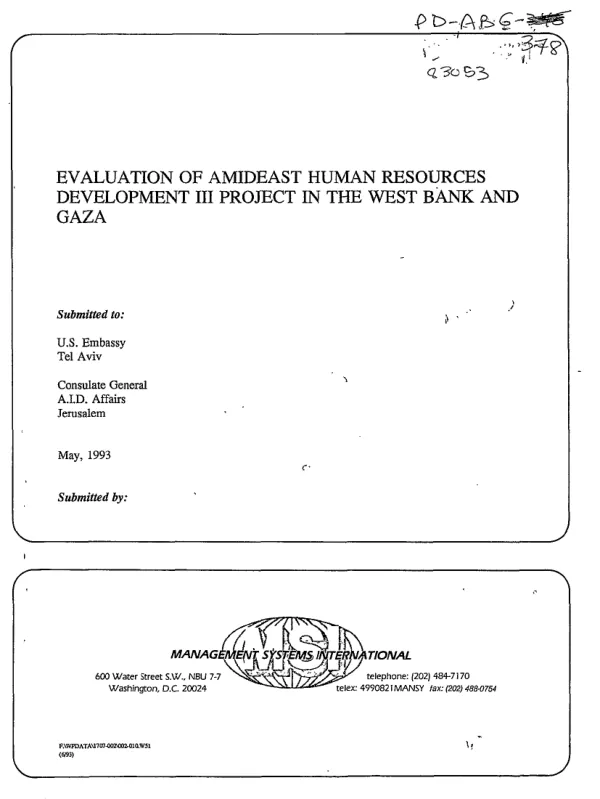
Evaluation of AMIDEAST human resources development III project in the West Bank and Gaza
Sign inMANAGEMENT SYSTEMS INTERNATIONAL, INC. (MSI)
Evaluation of AMIDEAST human resources development III project in the West Bank and Gaza
Final external evaluation of Phase III of a project (10/87-4/93) to develop human resources in the West Bank and Gaza.
Marrash, Richard; Davies, Philip · 1993
Sign in to readA free account is required to download.
Abstract
The project was implemented by AMIDEAST. The chief obstacle to success continued to be the destabilizing effects of the Israeli occupation. Specific findings are as follows. (1) Faculty development shows tangible results. About 65% of M.S. and Ph.D. degree holders in the faculties of local universities received their degrees through the project, which also funded 36 studies by faculty. However, while the research sponsored had intellectual merit, its application to the practical problems addressed by the AMIDEAST program was not always evident. Institutional development of the universities is problematic, as they struggle to recover from the extended closures caused by political turmoil (all universities had reopened by 6/92). (2) Health personnel training reportedly had favorable impacts at the individual and institutional levels; site visits confirm its benefits at the service delivery level. A solid nucleus of medical reference collections has been established, which some assisted institutions are making the effort to maintain. The objective of improving bed/clinic and patient/staff ratios was beyond the project"s scope. (3-4) While interviews and field visits elicited substantial anecdotal evidence of positive change from institutional development efforts, objective assessment was hampered the fact that AMIDEAST maintains neither baseline nor progress indicators on this component. The situation in the professional development component was similar. (5) AMIDEAST has enhanced the ability of several key institutions to deliver training and TA to small businesses; however, the training needs to be more focused and prioritized based on employment effects in productive sectors. AMIDEAST is instituting measures along these lines, including establishing a monitoring system to track performance indicators for small business training. (6) Except in the case of the Business Development Center at Bethlehem University, efforts to strengthen linkages between universities and the business community were not fruitful. Neither side showed much enthusiasm for the concept, and it proved to be more labor-intensive for AMIDEAST than anticipated. The extended closure of the universities was a serious obstacle. AMIDEAST has redesigned the activity to support new continuing education centers for businesspersons; this new focus holds promise. (7) There were numerous difficulties in implementing the English as a Second Language component, including evacuation of staff during the Gulf War and problems in finding suitable local partner institutions. Nevertheless, the program is the only one of its kind in the area and serves an important need; the search for good local partners should continue. (8) The basic education program is an innovative effort, and initial results are quite positive (the program is in the start-up phase). The program should be continued, as it could probably be expanded to include public schools if and when Palestinian autonomy takes hold. Overall, the demnads for implementing the multiple components of the project distracted attention from the project"s principal purpose of strengthening institutional capacity. AMIDEAST needs a formal system for tracking indicators in order to demonstrate the impact of its philosophy of strengthening institutions through individiual skills training and professional development. The project taught the following lessons. (1) Promoting institutional development under the burden of military occupation poses numerous challenges, some of which are beyond the scope of projects of this type. (2) Given the number of variables affecting organizational development, even in smaller organizations, it is not always clear to what extent specific changes are due to the project. (3) Strategic planning is an important tool for managing large and complex projects, especially in unstable environments. (4) Project managers have ongoing responsibilities for project monitoring and evaluation, and these responsibilities need to be carefully defined, as was not the case in this project.
Related documents