USAID DEC
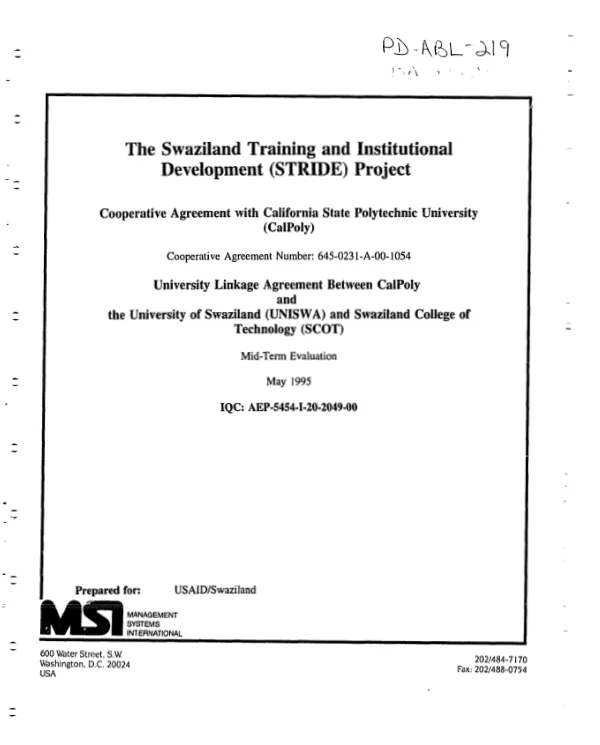
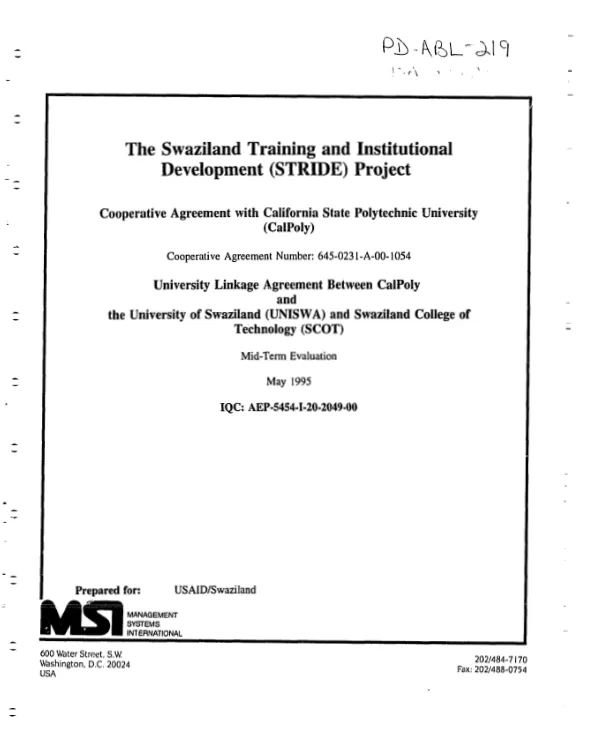
Swaziland training and institutional development (STRIDE) project -- cooperative agreement with California State Polytechnic University (CalPoly), cooperative agreement number 645-0231-A-00-1054 -- university linkage agreement between CalPoly and the University of Swaziland (UNISWA) and Swaziland College of Technology (SCOT) : mid-term evaluation
Sign inMANAGEMENT SYSTEMS INTERNATIONAL, INC. (MSI)
Swaziland training and institutional development (STRIDE) project -- cooperative agreement with California State Polytechnic University (CalPoly), cooperative agreement number 645-0231-A-00-1054 -- university linkage agreement between CalPoly and the University of Swaziland (UNISWA) and Swaziland College of Technology (SCOT) : mid-term evaluation
Evaluates component of the Swaziland Training and Institutional Development Project to establish a linkage between California State Polytech University/Pamona (CalPoly) and two Swazi training institutions -- the University of Swaziland's (UNISWA's) Faculty of Commerce and the Swaziland College of Technology (SCOT).
1995
Sign in to readA free account is required to download.
Abstract
Midterm evaluation covers the period 12/91-5/95. Although the linkage program has not been clearly and mutually articulated, progress has been made in several areas: (1) the professional levels and skills of the UNISWA's Faculty of Commerce and the SCOT have been improved; (2) the competencies of UNISWA and SCOT students have been enhanced; (3) the accounting, business, management, and marketing curricula have been expanded; and (4) and UNISWA and SCOT have developed linkages with Swazi business and government communities. CalPoly has provided commodities such as computers, related hardware and software, textbooks, audiovisual equipment; and TA centering on computer training, curriculum development (including computerization of curriculum), introduction to new methods of teaching, and faculty substitution. Both UNISWA and SCOT have made efficient use of TA offered through the linkage. UNISWA's Faculty of Commerce has established an Executive Advisory Council, consisting of private and public sector individuals who are working with the faculty to improve the quality and relevancy of the curricula. In addition, UNISWA has utilized CalPoly's TA to shape its marketing curriculum. SCOT has utilized CalPoly TA to structure its Level III Association of Accounting Technicians (AAT) certification curricula, develop a curriculum for micro- and small enterprises, and form a committee which markets SCOT to the Swazi business and government communities. For its part, CalPoly has used the linkage to internationalize its curriculum (and to thereby obtain accreditation for its business school), and to provide participating faculty opportunities for publishing and for analyzing their teaching methods. Several managerial, cross-cultural, public relations, and communications problems have limited further progress. (1) Failure to define the mutuality of interest among linkage participants and the absence of an effective management and communication system from CalPoly has resulted in false and unrealized expectations on the part of UNISWA and SCOT, while the absence of a thorough and systematic needs assessment by linkage participants may have resulted in less than optimal use of linkage resources. (2) CalPoly has failed to provide monthly reporting of activities and expenditures as required, and spent in excess of current USAID/S obligations. (3) The absence of Swazi participation in determining and controlling how grant monies are spent has led to dissatisfaction -- only partially justified -- on the part of UNISWA and SCOT, neither of whom, moreover, have fully utilized linkage assistance by adequately institutionalizing curricular methods and policies.
Related documents
Documents in this collection
 1995
1995USAID DEC
Swaziland training and institutional development (STRIDE) project -- cooperative agreement with California State Polytechnic University (CalPoly), cooperative agreement number 645-0231-A-00-1054 -- university linkage agreement between CalPoly and the University of Swaziland (UNISWA) and Swaziland College of Technology (SCOT) : mid-term evaluation
Open record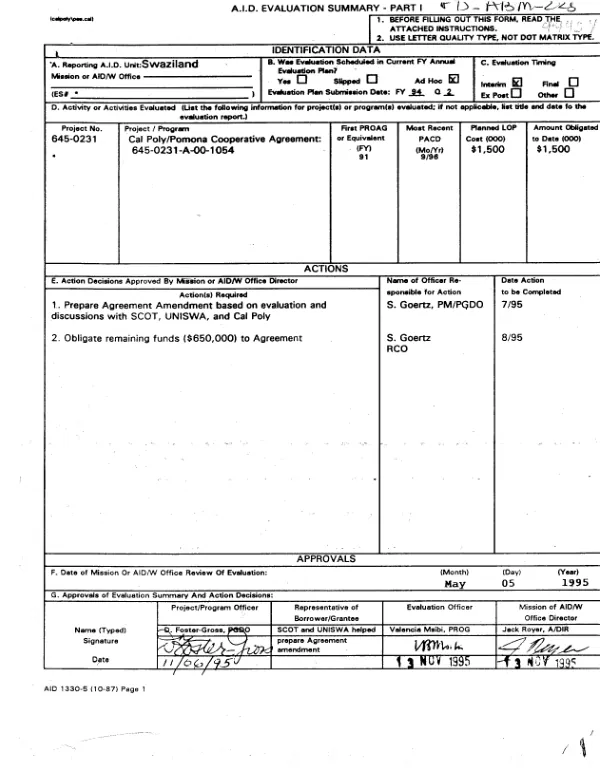 1995
1995USAID DEC
![Mid-term assessment of the Swaziland training and institutional development project (STRIDE) (project 545-0231 [i.e. 645-0231])](https://covers.devme.ai/gen/7282.webp)