TVT ASSOCIATES
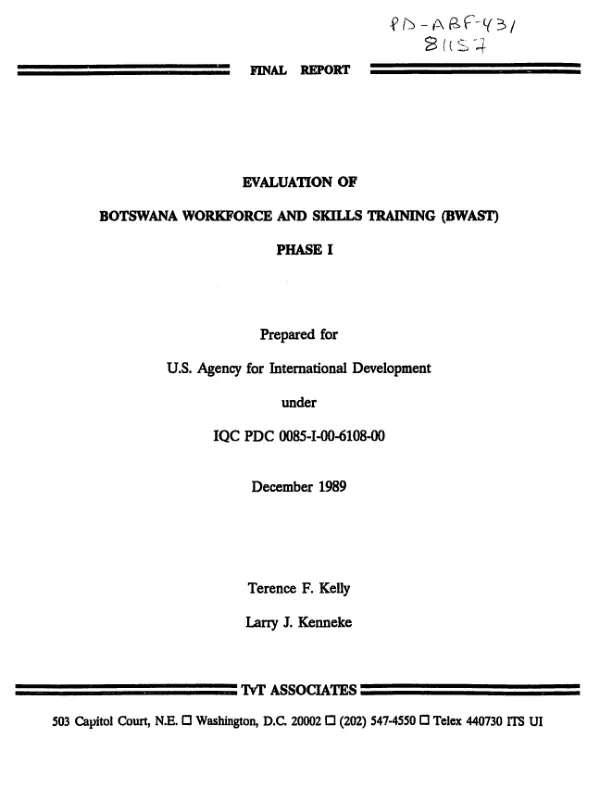
Evaluation of Botswana workforce and skills training (BWAST), phase I
Final evaluation of the Botswana Workforce and Skills Training (BWAST) project (1982-89).
Kelly, Terence F.|Kenneke, Larry J. · 1989
Sign in to readA free account is required to download.
Abstract
Project inputs were funds, continuity, TA, imagination, dedication, and trust among actors. Its primary outputs were, first, a number of trained and educated, middle- and high-level cadre, who are assuming positions of trust and preparing the path for Botswana's future development. Most concede that a managerial and administrative skill base is a prerequisite to the successful execution of more specific employment-generation projects. Second, the project (with its successor, BWAST II), has produced a management system to further the development of the human resource base in Botswana. An operative system is in place and functioning for the public sector and one is emerging in the private sector. The total system has been 16 years in the making, which appears to be about the minimum period necessary for skills development programs to have an appreciable effect and measurable impact on broad-based national development processes. Taking into account the combined effects of previous skill-upgrading programs, the activities of the government itself, BWAST, and programs of other international donors, Botswana's system of skills development appears to be 3-5 years ahead of those of many of its neighboring countries. Most of what the project did, it did well. However, while the project paper emphasized rural development, only 21% of courses taken by participants were related to rural or agricultural activities. Also, the expectation of immediate direct employment impact might have been more modestly presented in the project paper; training was targeted at already-employed individuals, so that indirect effects are likely to be of much greater significance, and will not likely be realized until some time in the future. This should not detract from project outputs, many of which have been clearly beneficial for the development outlook; rather we are suggesting that some of the rhetoric initially used to describe project objectives was overstated. We find no evidence of resource wastage in the implementation of the project, although overseas training, particularly in academic institutions, is intrinsically expensive. Outputs exceeded targets for every category for which measurable indicators could be derived and the project has been brought in under budget. The use of operational experts (OPEXers) proved highly effective, even though linkages with participant trainees were tenuous. On-the-job training by OPEXers was less than originally envisioned as the government seemed more interested in production than training. The TA function of the project has been particularly effective. Lack of overlap between OPEXers and participants could have been anticipated, given the numbers and timing of this component. This points to a larger problem of reintegrating people who are away for training for 2 to 4 years. The primary contractor, the Academy for Educational Development, managed a complex logistical problem admirably. Field staff members have provided a further valuable source of TA, particularly with a management-of-training system. As with all such projects, there were initial problems of implementation, but they were uncovered and, where feasible, corrected. A.I.D.'s analysis of project performance could be improved. Costs per participant should be routinely analyzed and a database developed of participant backgrounds and systematic measures of project achievements (number of jobs created, regulations improved, wage histories, etc.). It would have been useful if the data kept on participant backgrounds were such that they were more suitable for analysis and assessment. The evaluation plan in the project paper was neither specific nor comprehensive, particularly lacking rigorous monitoring and adherence to recordkeeping benchmarks. The training system which has been developed under BWAST is sustainable. What is not likely sustainable without additional assistance or internal financing, is funding for overseas training and TA. Further development of the private-sector component will require further funding. Such a commitment is well-justified by experience to date. It is recommended that in future skills development be approached as an investment decision. Skills development should first and foremost be directed to economic growth within the context of appropriate technology. The objective is to select one or more interventions (investments), which could maximize the employment content of economic growth, subject to constraints on fiscal and monetary policy, the international competitive situation, the human capital base, tastes and customs, the efficiency of Government operations, and the like. Interventions would then be selected either because they appear to have a high payoff, in the sense of yielding a large number of jobs directly or indirectly, or because they have low costs, in the sense that they are intrinsically inexpensive or because they can be directed at the reduction of one or two critical constraints. If such a procedure were followed and the costs and benefits of the alternatives were to be listed, it would be likely that attention would focus on: export opportunities, the service sector, construction, and certain distributive activities (retail and wholesale trade, informal sector, transportation, communications, business services, etc.). Moreover, skill constraints would be most apparent in the areas of basic attitudinal and commercial skills and supervisory skills (foremen). We thus urge that A.I.D. begin to move down into the heart of the skills pyramid, with less reliance on academic credentials as selection criteria. Attention would thus shift beyond exclusive focus on white-collar jobs to encompass more blue-collar and other operative occupations. Short-term, in-country courses would be emphasized in an effort to further strengthen the private sector. We particularly favor internships in the U.S. or in developing countries. Interventions should not be limited to skills upgrading, but should comprise a package of inputs including TA to smaller firms and aspiring entrepreneurs. Coordination of the various elements of such a package approach is essential, and a system which provides for that coordination is described in Section V. Financing is of equal importance, and we urge the introduction of cost-sharing and user charges where appropriate. We further suggest that a levy/grant system be considered. (Author abstract)