USAID DEC
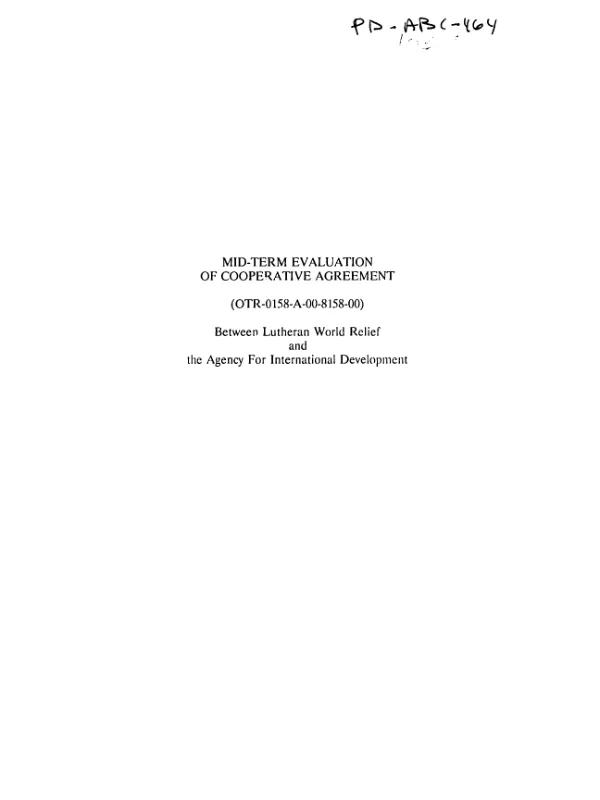
Evaluation of cooperative agreement with the Christian Reformed World Relief Committee
Sign inHARVARD UNIVERSITY. JOHN F. KENNEDY SCHOOL OF GOVERNMENT
Evaluation of cooperative agreement with the Christian Reformed World Relief Committee
Evaluates a cooperative agreement with the Christian Reform World Relief Committee (CRWRC) to improve the quality of rural life in Bangladesh and Belize.
Montgomery, John D. · 1990
Sign in to readA free account is required to download.
Abstract
All provisions of the cooperative agreement are on track. The detailed goals developed by the CRWRC for the country activities supported by A.I.D. have been converted to country programs, and the degree of goal attainment, recorded in annual and semi-annual reports, has been, in the judgment of this team, satisfactory. Field evaluations have been frequent and for the most part comprehensive. Benefits delivered to farmer groups and refugee communities have been identifiable and are recognized by the intended beneficiaries. The degree of institutional sustainability is still in some doubt in both northern and southern projects in Belize, and alternative approaches for their continued usefulness and viability are under review. Prospects for institutional adaptation in Belize will constitute the major concern for the future of the program, which is scheduled for phase-out by 1993. Both Bangladesh sites show evidence of group institutionalization and mounting activity. The establishment of a national board is underway to assume responsibility after CRWRC's support has been withdrawn. Relations between A.I.D. and CRWRC/Grand Rapids are formal but distant. A.I.D.'s policy of rotating personnel has precluded the development of strong personal ties; A.I.D. has responded perfunctorily, but for the most part adequately, to CRWRC initiatives, but without much consideration for CRWRC's distinct qualities as a PVO, especially in matters involving financial flexibility. TA has been rendered effectively to field operations through joint A.I.D./CRWRC training activities. A.I.D.'s field missions have not had close relations with CRWRC staff members, especially in Belize, but the general posture has been supportive and sympathetic, particularly in Bangladesh. Distribution of this report within A.I.D./PVC should be accompanied by a frank discussion of future relations between the two parties, held at A.I.D.'s expense in Washington and including three or four CRWRC representatives. Communications between CRWRC/Grand Rapids and the field are excellent. There is some reason to believe that evaluations and field visits have been, if anything, too frequent to be cost-effective. The policies regarding abstention from the direct supplying of capital to beneficiaries are sound, given the goals of the program, and given CRWRC's ingenuity in generating support from other sources that could provide longer-term continuity to the local institutions involved. But the goal of sustainability needs to be reviewed carefully to insure that it does not result in unwise and premature withdrawal from projects that could continue to benefit from continued collaboration. The austerity of management style dominating project operations is appropriate and cost-effective, and should not be altered. The interjection of diaconal goals is in harmony with the basic philosophy of the organization and is a powerful support to field operations and the morale of both staff and beneficiary participants. The use of quantitative indicators as measures of progress should be continued, but the formal reporting of goal attainment should be simplified, and the field should devote less attention to the injection of numbers and more to the consequences (including indirect effects) of CRWRC outputs. The indicators themselves should be carefully reviewed to insure that they do not displace other measures of success that would be more meaningful to field workers. (Author abstract)
Related documents