USAID DEC
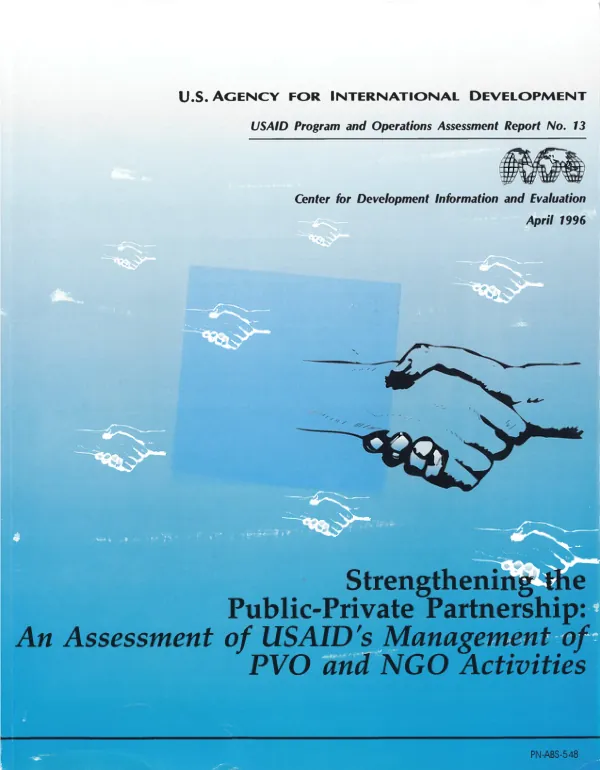
Strengthening the public-private partnership : an assessment of USAID's management of PVO and NGO activities
Sign inUSAID. BUR. FOR POLICY AND PROGRAM COORDINATION. CENTER FOR DEVELOPMENT INFORMATION AND EVALUATION (CDIE)
Strengthening the public-private partnership : an assessment of USAID's management of PVO and NGO activities
In recent years, donors, academics, development professionals, and members of Congress have recommended that, given the importance of grass-roots organizations, PVOs and NGOs should play a larger role in development and advocacy efforts.
Jordan, Patricia L. · 1996
Sign in to readA free account is required to download.
Abstract
This assessment examines the working relationship between USAID and the PVO/NGO communities, and suggests ways to improve the relationship. It also looks at how USAID does business -- that is, at the processes involved -- as distinct from the development impact of USAID-funded PVO and NGO activities. Major findings are as follows. (1) A lack of consistency pervades USAID's use of the various funding instruments; few practical differences exist in the management of grants and cooperative agreements, and many USAID project officers impose onerous controls on each instrument. Additionally, there is a perceived contradiction between the presumed "hands off" management of grants and the Agency's accountability requirements. (2) NGOs appear to have more difficulty than PVOs in meeting USAID accounting and financial management requirements, although lack of registration is not a major hindrance to obtaining Agency funding. (3) Negotiation is seen as an especially difficult process, and goes more smoothly when USAID uses a team approach or when implementers have a single USAID contact person. (4) Agency regulations seem too complex for small organizations to understand, and financial reporting requirements are excessive. (5) Neither PVOs nor NGOs are significantly consulted in the development of USAID global and country strategies. (6) PVOs and NGOs strongly support the concept of cost sharing, but would like more flexibility in its application. (7) PVOs and NGOs are concerned about project sustainability, with beneficiary participation in project design and implementation seen as an important ingredient of success. (8) Compared with other donors, USAID's strengths are its in-country presence and its ability to directly fund indigenous NGO activities. Recommendations focus on immediate management actions which for the most part do not require revisions to the Agency's policies and procedures. A bibliography is appended.
Related documents