USAID. MISSION TO HONDURAS
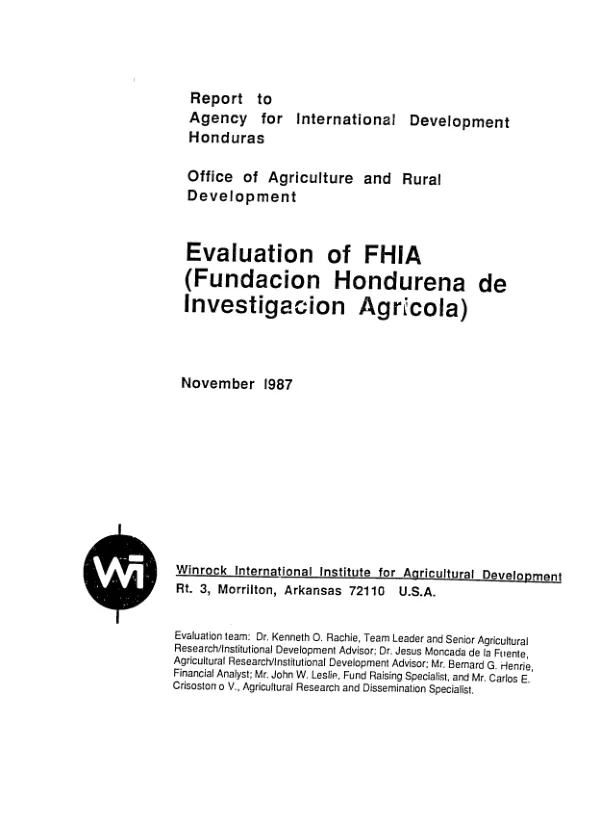
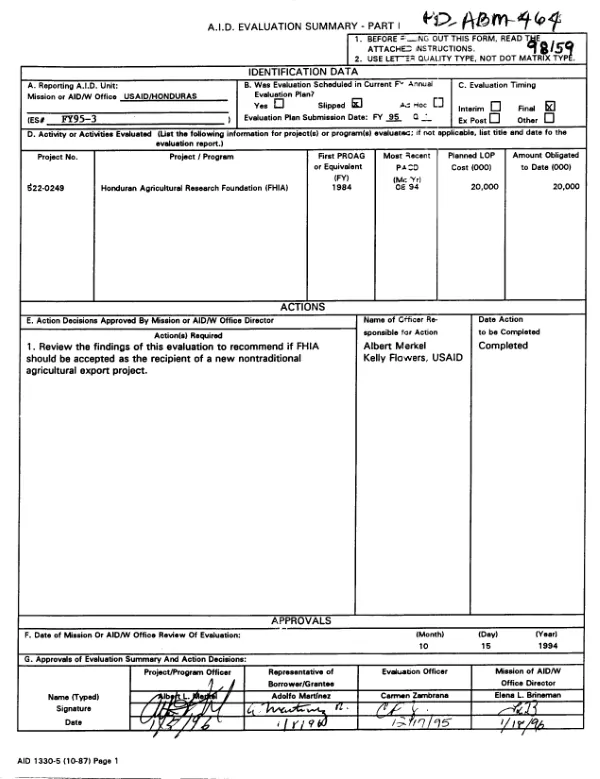
Evaluation of FHIA (Fundacion Hondurena de Investigacion Agricola) (November, 1987)
Summarizes external evaluation (PD-AAW-840) of a project to support the Honduran Agricultural Research Foundation (FHIA), a private research organization involved in developing non-traditional export crops.
1988
Sign in to readA free account is required to download.
Abstract
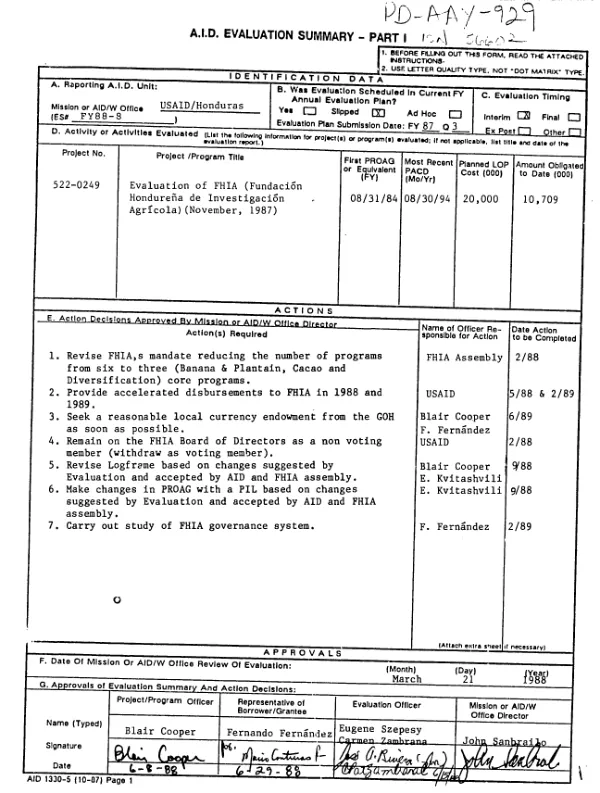
Interim evaluation covered the period 1984-88 and was based on briefings with USAID/H and FHIA staff and site visits. FHIA is far and away the most efficient and effective research institution in Honduras and, perhaps, the region. It should be commended for establishing itself and addressing its mandate within a short 3-year span. Facilities are well-developed and professional staff of high calibre. FHIA has developed viable research programs in six crops, including promising work on new, high-yielding and disease-resistant varieties of bananas and plantains. Banana farmers in Central and South America stand to save $100 million per year in costs associated with Black Sigatoka control thanks to FHIA research. Despite these heroic efforts, however, existing project resources are inadequate for the scope of effort required. FHIA"s original mandate was not only too broad, but also ill-suited for FHIA"s evolving role and potential clientele. While research programs in bananas, citrus and vegetables, and cacao have proceeded well, FHIA is understaffed in key areas and its management is often preoccupied with institutional development to the point of neglecting other crucial areas, such as financial development or beneficiary targeting. A number of recommendations address these issues. Most important, FHIA should redefine its mandate (with help from USAID/H) to emphasize research on export crops, and develop a way to prioritize ongoing research and add or reassign positions to add depth to understaffed departments. FHIA funding should be reexamined as well: FHIA should ask A.I.D. to front-load funds for 1992-3 for use in 1988-9, and to establish, with the GOH, an endowment to provide long-term support for the core research fund. If the endowment is not practicable, A.I.D. should consider funding a 10-year follow on project. In addition, FHIA should aggressively seek other kinds of funding from both the public and private sectors. The project teaches that (1) good fiscal planning and careful definition of the institutional mandate are necessary to ensure that institutional development does not outstrip financial resources; (2) research institutions like FHIA need to establish good relations with several other related institutions in order to build a national and international identity; (3) FHIA should discontinue funding the citrus and vegetable programs unless key marketing constraints (e.g., transportation costs) can be overcome; and (4) obtaining non-A.I.D. funding is very difficult and will take more time than originally thought.
Related documents