USAID DEC
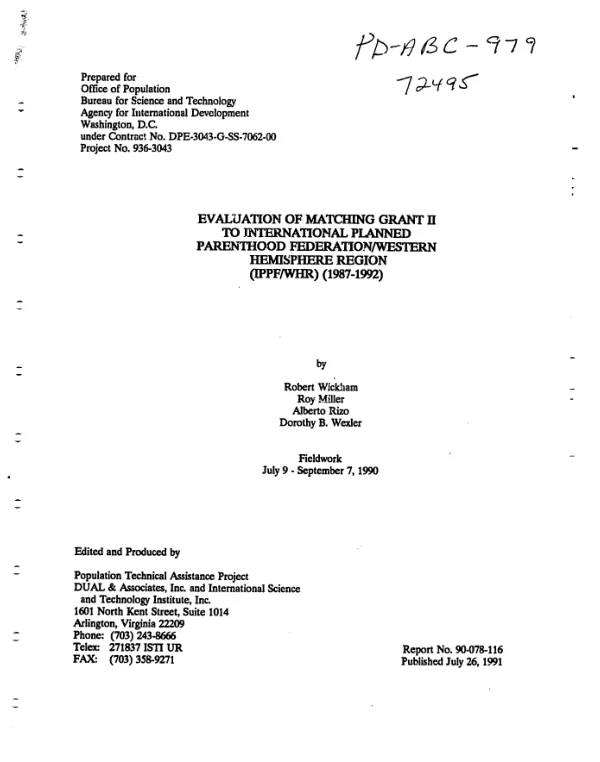
Evaluation of matching grant II to International Planned Parenthood Federation/Western Hemisphere Region (IPPF/WHR) (1987-1992)
Sign inDUAL & ASSOCIATES, INC.
Evaluation of matching grant II to International Planned Parenthood Federation/Western Hemisphere Region (IPPF/WHR) (1987-1992)
Interim evaluation of a program implemented by International Planned Parenthood Federation (IPPF) to assist its affiliated family planning associations (FPA's) in improving services and internal management.
Wickham, Robert|Miller, Roy · 1991
Sign in to readA free account is required to download.
Abstract
The evaluation covers the period 7/87-9/90. The project, which has focused on FPA's in Brazil, Colombia, and Mexico, with smaller subgrants to FPA's in nine other countries, has accomplished many of its goals. The assisted FPA's are well on their way to attracting the expected 2.8 million new acceptors, many of whom are from the targeted low-income populations in low-prevalence areas. Overall services are good, although some clinics are too crowded and require long waiting periods. The FPA's have also developed links with government and PVO programs that have stimulated more and better quality services by both types of organizations and diversified the resource base of the FPA's. More, however, needs to be done in the area of formal documentation and dissemination. The project's stringent planning and financial reporting requirements have helped improve FPA abilities in planning and monitoring. A new management information system has been developed under the project and is gradually being installed. The only serious problem has been the very long delay in hiring an individual to carry out the regional evaluation component. The evaluator was expected to analyze whether low-income/low- prevalence populations were being reached and to develop a plan for dissemination of innovative service delivery models, among other duties. Since 1986, the FPA's have succeeded in increasing their income from outside sources; matching grant support has dropped from nearly one-quarter of their aggregate budgets to only about one- sixth. This has been accomplished in good measure by charging for services; however, there is potential for increased cost recovery. IPPF has been concerned by recent A.I.D. funding uncertainties, particularly the unwillingness to forward fund. On the other hand, IPPF has resisted suggestions that it be moire flexible in its planning and more prudent in the rate at which it expends funds. Given the project's success, it is recommended that the grant be renewed in 1992.