INTERNATIONAL SCIENCE AND TECHNOLOGY INSTITUTE, INC. (ISTI)
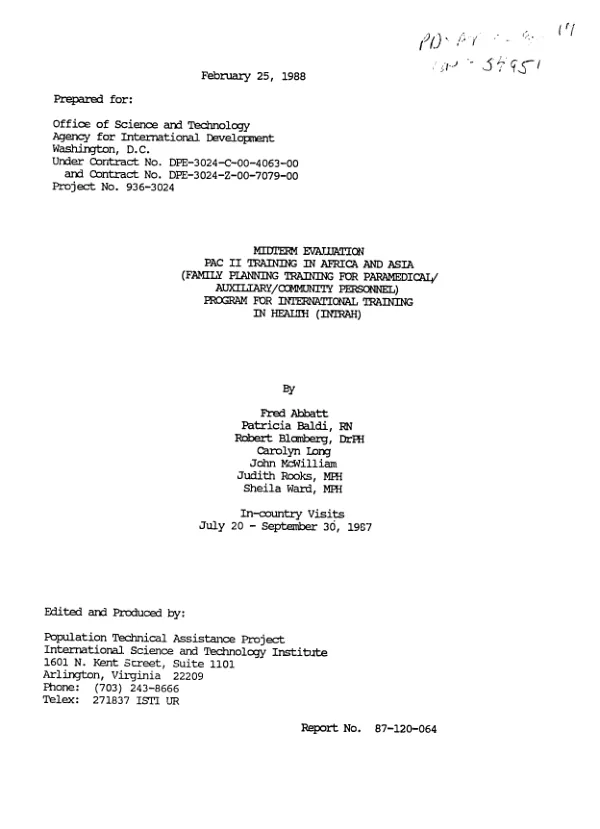
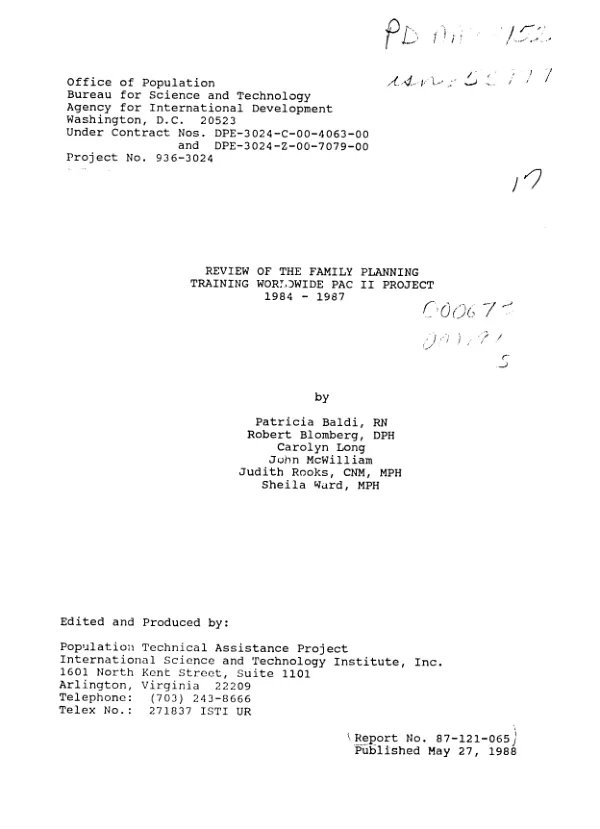
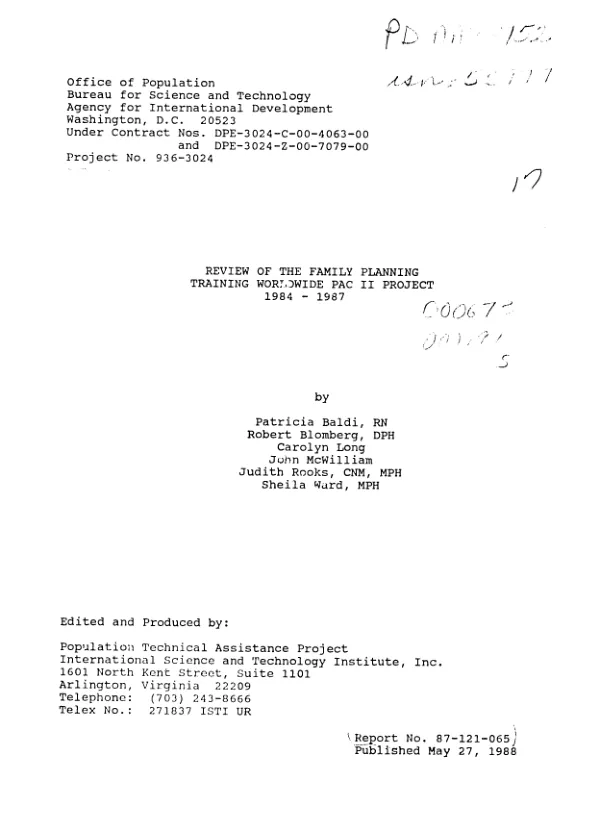
Review of the family planning training worldwide PAC II project, 1984-1987
Evaluates project to strengthen the capacity of LDC institutions to develop family planning (FP) training programs for paramedical, auxiliary, and community (PAC) personnel.
Baldi, Patricia|Blomberg, Robert · 1988
Sign in to readA free account is required to download.
Abstract
External evaluation covers the first 2.5 years of the 10-year project. Progress has been made in a number of areas. The number of trainees has already exceeded target in Asia and Latin America (regions with more highly developed training institutions), while being on target in Africa, and falling short in the Near East/North Africa region. Only in Africa has any progress been made in developing pre-service curricula -- probably because the need for in-service training remains relatively more important. The project has apparently served to enhance the status and responsibility of PAC workers in some cases (though much remains to be done); to increase access to FP services in rural Asia and Latin America (though not in Africa, where efforts in rural areas are tied to the government's ability to provide basic health care); and to increase contraceptive use in some cases (though not enough to affect contraceptive prevalence rates). Project contractors (which have responsibility for different geographic regions) are pursuing two major institution-building strategies: strengthening training institutions; and strengthening country training systems. The latter, being broader, may take significantly longer to accomplish, especially in Africa, where FP services are delivered mainly through Ministries of Health, which are resistant to change. Related to institutionalization, three major issues which have arisen during the project should influence programming decisions in the near future: (a) the proper mix between pre- and in-service training of nurses and (b) between training of community-based and clinic-based workers; and (c) whether personnel should be trained to work in integrated primary health care/FP programs. Training targets have been appropriate, but a major weakness has been a failure to develop indicators of training quality, resulting in an unsystematic approach to training of trainers and a lack of guidelines for training community and clinic-based workers (these guidelines, however, are now being developed separately by two of the contractors). There is also a need to: consider client (rather than PAC worker) needs when designing training programs; include AIDS in the curriculum; produce/disseminate more training materials; and increase contractor networking. All contractors are experiencing difficulty in developing the capacity of regional institutions. The centrally funded approach to this project has proven appropriate. The use of several contractors has also proven beneficial, although a single contractor might offer other advantages.
Related documents
Documents in this collection
 1988
1988USAID DEC
Review of the family planning training worldwide PAC II project, 1984-1987
Open record 1988
1988USAID DEC