USAID DEC
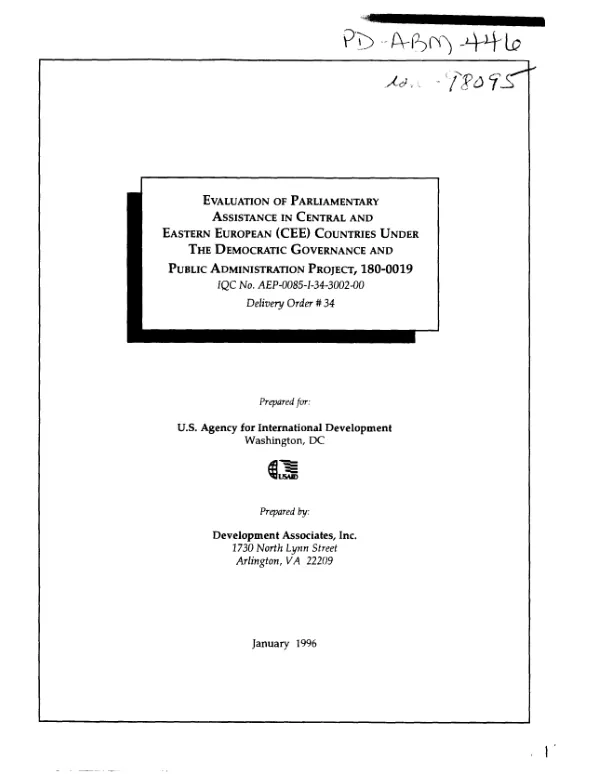
Evaluation of parliamentary assistance in Central and Eastern Europe (CEE) countries under the democratic governance and public administration project, 180-0019
Sign inDEVELOPMENT ASSOCIATES, INC.
Evaluation of parliamentary assistance in Central and Eastern Europe (CEE) countries under the democratic governance and public administration project, 180-0019
Final evaluation of a project to provide short-term assistance to emerging legislatures in Poland, Hungary, Czech Republic, Slovakia, Latvia, Estonia, Lithuania, Bulgaria, and Albania.
1995
Sign in to readA free account is required to download.
Abstract
The project, coordinated by the Frost Task Force, began in 1991 and consisted of three main activities: equipment provision, TA provision, and the development of library collections. It ended in 7 countries in 4/15/95, but continues in Albania and Slovakia and has just begun in Romania. The project was universally praised for its timeliness, impact, quick implementation, and because it was unconditionally responsive to parliaments' wishes. As a result of the project, emerging parliaments are turning out more needed legislation and getting new laws published more quickly; they could be from 3 to 10 years ahead of where they would have been without the assistance. The quality of legislation varies by country; in some countries it is nominal, but as newly initiated programs mature, it is expected to improve. Democracy strengthening, though not part of the project's mandate, seems to have resulted as well. There is general interest in continued cooperation with the U.S. Congress and other parliaments in the region, with an emphasis on cooperation in the field of informatics and the strengthening of legislative processes. In particular, (1) country conferences implemented for Members of Parliament were beneficial, particularly for new legislators and especially when held early in the term; (2) the Parliamentary Institutes were beneficial to parliamentary staff both in terms of the information imparted and the opportunity to meet peers from other countries; (3) research and analysis units have been established and are strong in Bulgaria, the Czech Republic, Lithuania, Poland (Sejm and Senat), and Slovakia; (4) the addition of books and periodicals to parliamentary library collections was welcomed because of the limited size of the parliamentary collections and their lack of Western publications; and (5) personal computers are being used to improve and speed up the operations of the libraries. Putting more information on-line, however, has occurred only in two of the four countries visited. Although the project has achieved its objectives of jump-starting the new legislatures, there is a need for some follow-on activity in some countries and a modified approach in Albania. In addition, while great strides have been made in utilizing the equipment provided, more could have been done and in less time (in Albania, Lithuania, and Bulgaria) if TA had been provided for automation start-ups. The following are lessons learned. (1) The jump start approach was appropriate for the countries on which project design was based (Poland, Hungary, the Czech Republic, and the Slovak Republic), but did not allow for long-term TA needed by the countries added later in the project, although these countries did benefit from the project. (2) A strong automation technology component is recommended in any new program; computers, and usually networking equipment and software, is extremely important for new parliaments to obtain and disseminate information, and to manage the legislative process effectively. In sum, the project was designed for a special situation at a special time in history. It was extremely successful given its limited time frame and operational framework. It is not necessarily the best formula for future programs because the same conditions are unlikely to exist.
Related documents