USAID DEC
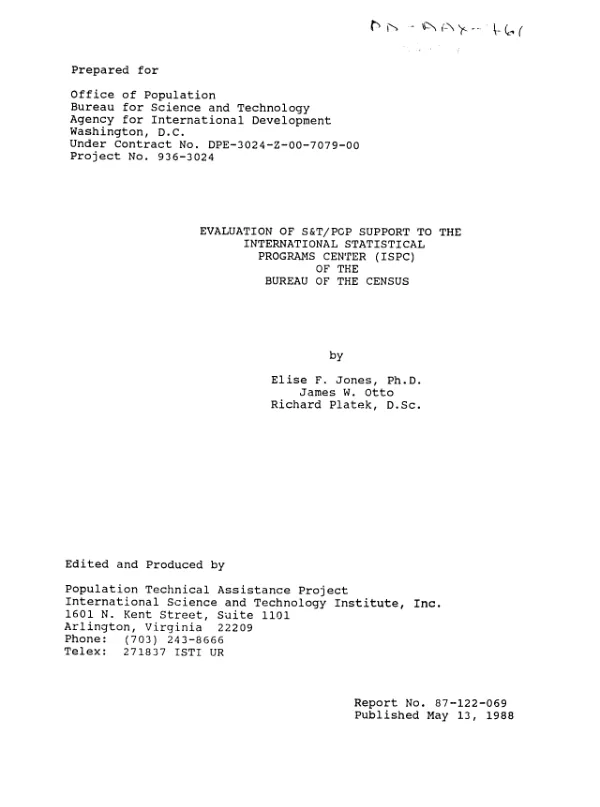
Evaluation of S&T/POP support to the International Statistical Programs Center (ISPC) of the Bureau of the Census
Sign inINTERNATIONAL SCIENCE AND TECHNOLOGY INSTITUTE, INC. (ISTI)
Evaluation of S&T/POP support to the International Statistical Programs Center (ISPC) of the Bureau of the Census
Evaluates project component, implemented by the International Statistical Programs Center (ISPC), to support LDC population censuses.
Jones, Elise F.|Otto, James W.|Platek, Richard · 1988
Sign in to readA free account is required to download.
Abstract
Interim evaluation covers the period through 5/88. By increasing increase LDC institutional capacity and skills in census taking, ISPC activities fill an important niche in the overall program of international assistance to census operations. IPSC staff seem to be functioning at top capacity, responding well to the pressure that exists to put out immediately salable products. In the process, there appears to be little room for the kind of creative activities that might be most productive in the somewhat longer run (i.e., the 1990 round of censuses). The heavy workload and a lack of resources have also resulted in too little attention having been given to communication in general, and to reporting and monitoring in particular. The assistance provided by ISPC, whether TA, training materials support or workshops, has on the whole been competent, professional, and timely. Workshops, particularly country workshops for persons involved in census data processing and mapping, have been pertinent and useful. The TA has been varied and has met many of the needs expressed by LDC personnel. ISPC publications, particularly Popstan, have been useful as guides to various aspects of census operations. A number of gaps were identified, however. Of prime importance were problems in planning and management, but there were also weaknesses in questionnaire design, data quality, and survey methods. There is some need for more in-depth treatment of technical areas. In addition, a lack both of French-speaking TA staff and French-language materials was identified. The Census Bureau software that has been and is being developed under another project component and with other funds has made feasible the processing of a national census on microcomputers. Human and financial resources are limited, however, for further major software projects. The gulf between data collection and data analysis - a familiar issue in census work in both developed and less developed countries - is clearly a problem in sub-Saharan Africa. The focus on collection to the exclusion of analysis means that the results are not adequately exploited for planning with respect to education, health, employment, and other critical areas, and the data required for projections and the study of population dynamics are often not being produced. Coordination among international organizations, among donors in the field, and among the various levels of A.I.D. deserves close attention. Problems exist at each level, leading to uncertainty in host countries and a piecemeal approach to planning. The ad hoc Committee on Interagency Coordination represents a promising start toward meeting one aspect of this need. (Author abstract, modified)