DEVRES, INC.
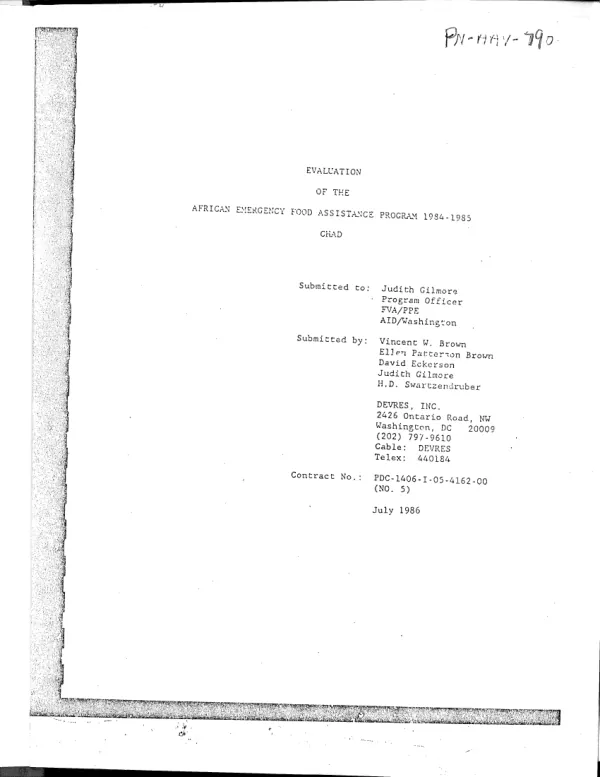
Evaluation of the African emergency food assistance program, 1984-1985 : Chad
A.I.D.
Brown, Vincent W.; Brown, Ellen Patterson · 1986
Sign in to readA free account is required to download.
Abstract
and other donors mounted a massive emergency effort to feed the 1.5 million Chadians affected by the 1984-85 drought. Despite its shortcomings, the program was a success, according to this evaluation. Based on secondary sources review and interviews and observations in Washington, D.C. and in the field, the evaluation presents detailed findings, conclusions, and recommendations in five key areas. The management strategy of using the World Food Programme (WFP) and private voluntary organizations (PVO"s), supported by a network of action committees under the Government of Chad (GOC), as the main implementing agencies proved very successful. Fuller and earlier delegation by AID/W to USAID/C of contracting responsibility would have helped avoid delays. Due to a lack of early warning, emergency preparedness, and contingency plans, available amounts of emergency food were insufficient in late 1984 and early 1985, diluting program effectiveness. Chad"s weak transportation and logistical systems - compounded by political problems - proved major obstacles. Still, the program saved many lives, especially among the 46% of the needy who received food in targeted programs of the WFP and PVO"s rather than through general distribution. Resettlement programs successfully limited the creation of spontaneous camps; some of those resettled were taught productive agricultural techniques. The GOC depended heavily on donors and PVO"s to define the health and nutritional impacts of the famine; PVO"s in particular did an excellent job of identifying geographical areas for emergency food distribution. However, lack of infrastructure greatly inhibited health efforts. Vitamin A deficiency was neither assessed nor treated, nor was oral rehydration therapy used extensively. The 1985-86 transition from emergency relief to development, spearheaded by prompt GOC action and strong PVO and donor support and facilitated by mechanisms such as Food for Work and resettlement, has gotten off to a fast start. The transition needs, however, to account for persons still at risk and to develop a strategy in case the drought recurs in 1986. Included are 10 general recommendations, 22 tables, 8 figures, and several detailed appendices.