USAID DEC
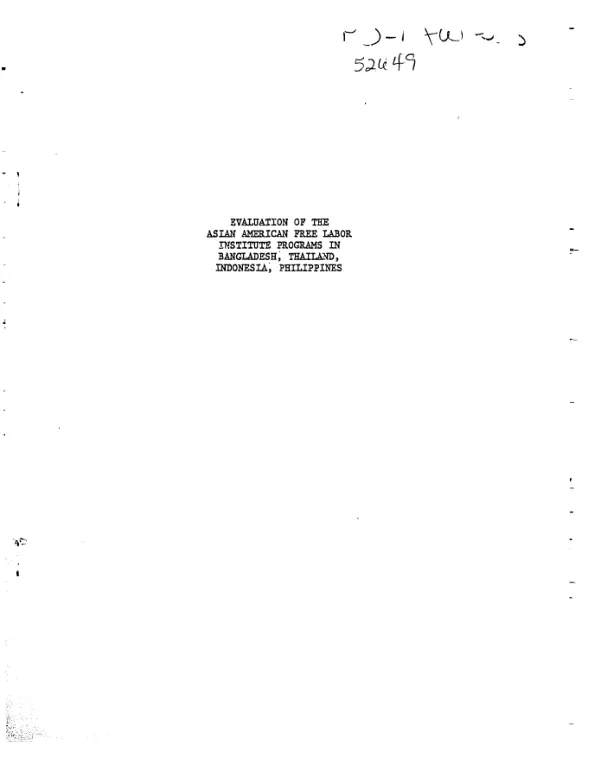
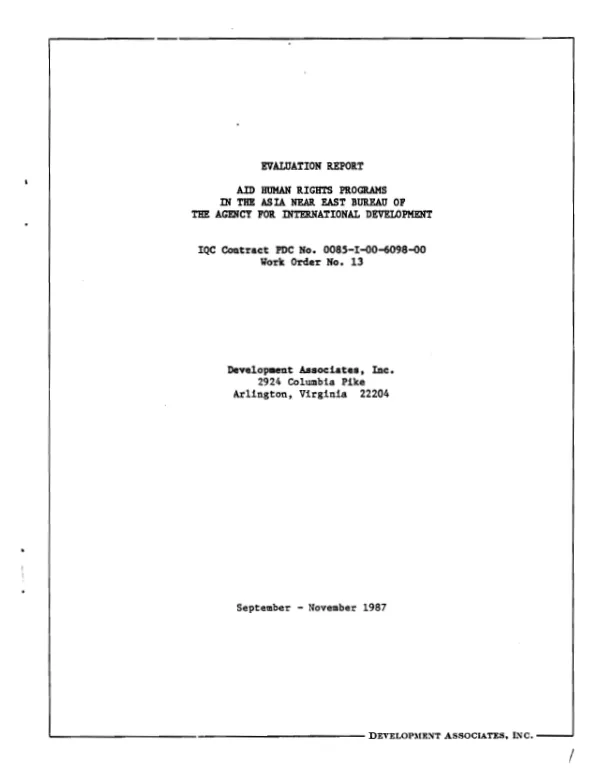
Evaluation of the Asian American Free Labor Institute programs in Bangladesh, Thailand, Indonesia, Philippines
Sign inDEVELOPMENT ASSOCIATES, INC.
Evaluation of the Asian American Free Labor Institute programs in Bangladesh, Thailand, Indonesia, Philippines
Evaluates programs of the Asian-American Free Labor Institute (AAFLI) in Bangladesh, Thailand, Indonesia, and the Philippines.
Forman, Lori|Bisek, Paul|Barrett, Jerome · 1987
Sign in to readA free account is required to download.
Abstract
External evaluation covers the period through 2/87 and is based on document review, site visits, and interviews with AAFLI field and Washington staff and A.I.D. officials. The AAFLI field activities of AAFLI programs have achieved a substantial impact in the four countries, and tend to be highly valued by local labor leaders. AAFLI's core activities in particular - training programs and corollary research and publication efforts - seem to be economical and well run, and have contributed significantly to the strength, size, and organizational capacity of free labor unions. Membership service activities, such as health clinics, on the other hand, have had only mixed success, primarily because AAFLI/W and field managers lack specialized expertise in these activities. Where membership services are successful, this is often attributable to AAFLI's use of contracted experts, a practice which raises serious questions concerning sustainability. Further, lack of planning for phasing over these activities to local support leaves AAFLI with no choice but to remain 100% dependent upon external funding, or eliminate programs as budgets are reduced. While the programmatic costs of AAFLI's field activities are generally modest, the same cannot be said of AAFLI's administrative and headquarters expenses. AAFLI's management of its activities is nonevaluative and unnecessarily costly; monitoring and reporting requirements are high and come at the expense of time better spent improving program design. At the same time, although AAFLI derives almost all its financial support from A.I.D., A.I.D.'s guidance to AAFLI has been sporadic. It is recommended that AAFLI focus on those activities which are directly related to its mission of union development and which it can clearly manage. All activities should include plans for phasing over to local support. Further, as A.I.D. budgets are declining, AAFLI should eliminate activities in non-A.I.D. countries and take steps to reduce its administrative costs and diversify funding sources (seeking more support from unions and the AFL-CIO in particular). In the meantime, A.I.D. should be given proper credit for its support in AAFLI programs and publications. A.I.D., for its part, should regularize management of the AAFLI grant (in the person of the PVO Officer), provide technical advice on improving AAFLI programs, and increase Mission-level oversight of AAFLI country activities. Specific recommendations are also made for each country examined. (Author abstract, modified)
![Evaluation of the US-Asia environmental partnership [US-AEP]](https://covers.devme.ai/gen/5422.webp)
![Evaluation of the US-Asia environmental partnership [US-AEP]](https://covers.devme.ai/gen/44258.webp)