CHECCHI AND CO. CONSULTING, INC. (CCCI)
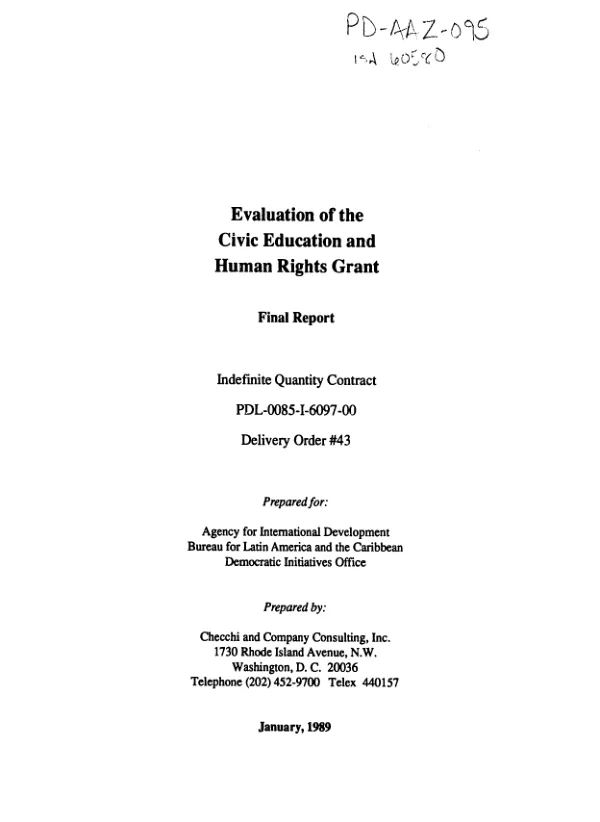
Evaluation of the civic education and human rights grant : final report
Final evaluation of a project implemented by the National Association of the Partners of the Americas (NAPA) and (as sub-grantee) the Corporacion Integral para el Desarrollo Cultural y Social (CODECAL) to promote civic and human rights education in Latin America.
1988
Sign in to readA free account is required to download.
Abstract
External evaluation covers the period 9/84-9/88. Although most activities proceeded as planned, the project evolved - contrary to what was mandated in the grant agreement - into two independent, uncoordinated projects. A main problem was CODECAL's unwillingness to accept TA from and work cooperatively with NAPA. Other factors included inadequate grant planning; a lack of serious evaluations, follow-up, and adjustment mechanisms; poor communication and reporting systems; and a financial reporting system which did not follow a consistent format and lacked detail. The project was also insufficiently focused, attempting overall to provide services for diverse target groups in overly extensive geographic and subject areas (20 countries and 37 subjects). It also lacked established trainee selection criteria. NAPA used grant resources to fund successful and ongoing programs. Particularly successful was the provision of a grant which enabled U.S. specialists to travel to Paraguay to help develop the idea for a College of Human Ecology at the Autonomous University of Paraguay. The idea has since been accepted and funded by the W.K. Kellogg Foundation for more than $1 million. For its part, CODECAL conducted 199 training programs in 10 different areas for 4,948 participants from 9 countries (2,227 of them from Colombia). The quality of these efforts was generally satisfactory, and CODECAL's participatory training approach showed many positive results. On the negative side, the impact of the training has not been as effective as planned. A significant number of the campesinos trained did not return home to train others to be trainers, although training of trainers was a major project objective. In addition, while user reactions to CODECAL's instructional materials was positive, the materials were not subjected to a serious, professional evaluation. Further, the lack of evaluation and feedback mechanisms made it difficult to determine whether CODECAL's programs had met real needs or not. Trainees from the Dominican Republic, for example, complained that the human rights course failed to address their most urgent problem - Haitian refugees. Other problems included a tendency to use inexperienced instructors, an at times excessively theological (Roman Catholic) orientation, and an overemphasis on Colombian values and examples. Recommendations for follow-on activities focus on the above-mentioned problem areas.
Related documents