USAID DEC
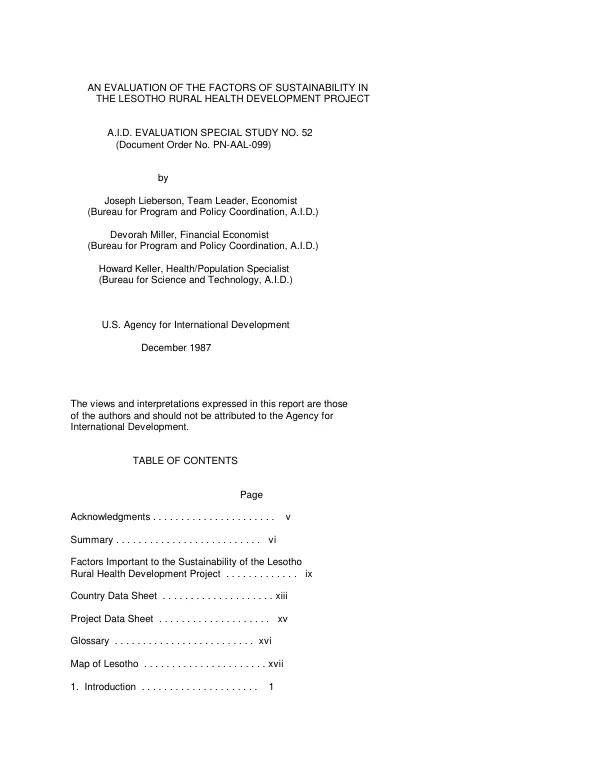
Evaluation of the factors of sustainability in the Lesotho rural health development project
Sign inUSAID. BUR. FOR PROGRAM AND POLICY COORDINATION. CENTER FOR DEVELOPMENT INFORMATION AND EVALUATION (CDIE)
Evaluation of the factors of sustainability in the Lesotho rural health development project
A.I.D.'s project to provide primary health care (PHC) in rural Lesotho by creating a cadre of paramedical physician-extenders (mainly, nurse midwives) and by strengthening the existing PHC management system to support this approach has proved sustainable, according to this evaluation.
Lieberson, Joseph M.|Miller, Devorah|Keller, Howard · 1987
Sign in to readA free account is required to download.
Abstract
A dovetailing of host country capacity and donor design contributed to this outcome. The project's technical package was appropriate to Lesotho's conditions and capabilities, while training, supervision, management, and logistic requirements were successfully institutionalized within the Ministry of Health. To alleviate the chronic problem of financial sustainability, the project was designed to gradually phase in Government of Lesotho (GOL) funding, so that by the end of the project the GOL was paying all personnel and nearly all training and supervision costs. The only threat to financial sustainability is the low level of user fees. For political reasons, the GOL has decided not to charge patients for the full cost of treatments, but GOL revenues have been falling and an International Monetary Fund reform package will require increased budget stringency. The GOL is already having problems with financing the current level of health services. The only choice is to increase the fees charged, and combined A.I.D. and World Bank pressure should persuade the GOL to do so. A number of lessons about health project sustainability can be learned from the Lesotho project; these include (inter alia) that: (1) project design should match the country's level of development and economic conditions; (2) adequate fees are necessary for financial sustainability, and fee structures should not discriminate against the poor (as was sometimes the case in Lesotho); (3) projects stand a better chance of success when they build on existing capabilities and personnel rather than start from scratch; (4) developing countries can better handle recurrent costs when they are gradually phased in according to a well ordered plan; (5) designers should stress the need for appropriate counterparts early in their dialogue with the host country; (6) health workers at all levels should receive appropriate guidance and supervision; and (7) it is important to involve all interest groups in the project early on (e.g., the Lesotho project worked hard to alleviate physicians' fear of competition from paramedicals). Includes references (1977-85).
Related documents