USAID DEC
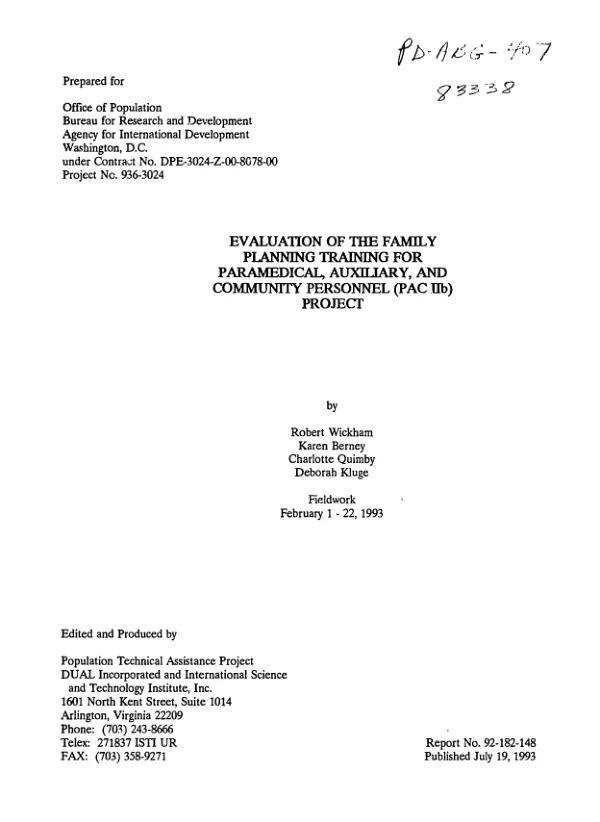
Evaluation of the family planning training for paramedical, auxiliary, and community personnel (PAC IIb) project
Sign inINTERNATIONAL SCIENCE AND TECHNOLOGY INSTITUTE, INC. (ISTI)
Evaluation of the family planning training for paramedical, auxiliary, and community personnel (PAC IIb) project
Evaluates project to increase the capacity of public and private family planning (FP) agencies in developing countries to design and implement FP training programs for paramedical, auxiliary, and community (PAC) personnel.
Wickham, Robert|Berney, Karen · 1993
Sign in to readA free account is required to download.
Abstract
The project is being implemented by the Program for International Training in Health (INTRAH) and Development Associates, Inc. (DAI). Interim evaluation covers the period 9/89-2/93. Both contractors have made very good, if not excellent, progress. INTRAH has carried out much of planned work in spite of weak institutional structures in Africa, and DA's work, particularly in India and the Philippines, appears to be on target. Both have identified strengthening training capability as their top priority; INTRAH is also addressing training needs generated by advances in contraceptive technology. However, several topics have been insufficiently addressed in project training, including supervision techniques, use of service statistics, client counseling, use of surveys and focus group interviews, and targeting of adolescents and men. Both contractors have included some training in AIDS and sexually transmitted diseases as a component of clinical training. Both contractors have focused on in-service training and have typically delivered high quality training that utilizes a range of educationally sound training methodologies and relies on competency-based strategies measured against performance standards. Both have also: (1) been involved in producing, revising, and distributing culturally appropriate field-tested materials, many of which have been translated into major languages; (2) developed extensive strategies and methods for evaluating training; (3) worked successfully to increase the capabilities of client institutions; (4) demonstrated, at the micro level, that their assistance has affected acceptor rates, method mix, numbers of referrals, and provider skills and knowledge; and (5) significantly influenced policies, norms, and regulations regarding the quality and availability of FP services. Both contractors have well-qualified, experienced staff (although the INTRAH regional office in Nairobi is understaffed) and have collaborated effectively with other A.I.D. contractors, USAID Missions, and donor agencies, though to a lesser degree with each other. Problems of conflicting mandates have been most effectively resolved at the country level. Less positively, both contractors have experienced difficulty working with A.I.D./W. (1) The Agency's daily participation in management and frequent informational requests have been disruptive. (2) The new Priority Country Strategy, which focuses on the larger countries in each region and was developed after the project contracts were let, has forced the contractors to reprogram in certain areas. (3) A.I.D. has separate offices for health and for population and separate cooperative agreements for these areas; this can make it difficult to provide integrated assistance in countries where "family health" rather than FP is the priority. (4) Both contractors have been receiving only 65-70% of planned budgets. As a result, the project has experienced an endless cycle of replanning and rebudgeting, stretching personnel to the limit and leaving them without a long-term planning horizon. A follow-on is clearly warranted.
Related documents