DUAL & ASSOCIATES, INC.
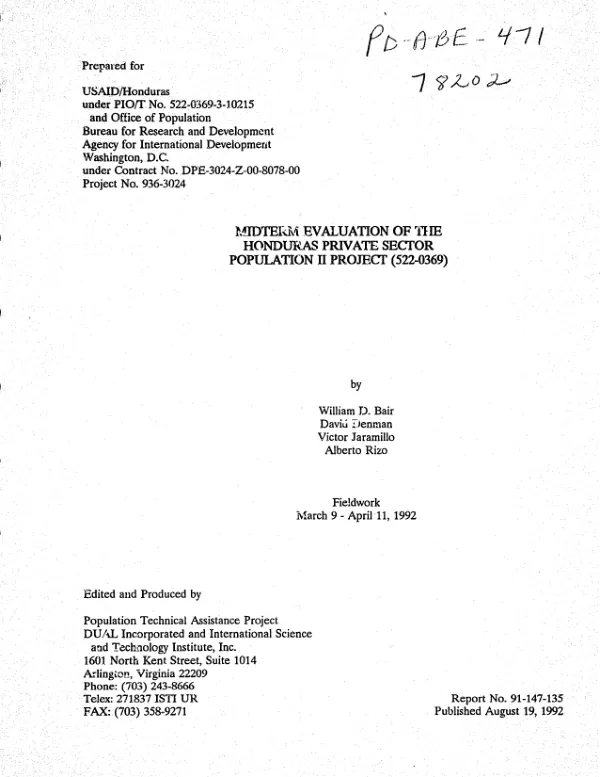
Midterm evaluation of the Honduras private sector population II project (522-0369)
Evaluates project to expand family planning (FP) services in Honduras, primarily through assistance to ASHONPLAFA, the Honduran affiliate of the International Planned Parenthood Federation.
Bair, William D.|Denman, David · 1992
Sign in to readA free account is required to download.
Abstract
Midterm evaluation covers the period 1989-92. The project has made good progress toward national contraceptive coverage despite substantial criticism from the Catholic Church. ASHONPLAFA now provides FP services in over 2,200 locations in all 18 departments and in 265 of 291 counties. Regionalization is also progressing; high-quality clinical services, especially voluntary surgical contraception, are being provided in 6 ASHONPLAFA clinics, and in a network of 8 private clinics supported by ASHONPLAFA. These regional clinics also back up the widespread Community Services Program (CSP) of community-based contraceptive distribution. With the help of MANDOFER, one of Honduras' largest pharmaceutical distributors, orals and condoms are being sold in 533 pharmacies and medicine stores under the Social Marketing Program (SMP), as well as by CSP distributors. All told, the project extended 210,000 couple years of protection (CYP's) during 1991, about 86% of target. In regard to self-sufficiency, ASHONPLAFA has increased locally generated funds by 54%, largely through client charges, and SMP and CSP surpassed their respective targets of 100% and 50% self-sufficiency during 1991. Other accomplishments include, inter alia, development of an information, education, and communication (IEC) strategy; training of 1,491 persons in country and abroad, as well as assistance (through contracts with PLAN International and the Population Council) to PVO's in training another 1,500 community workers; and completion of fieldwork for the 1991 Epidemiology and Family Health Survey. Due to a combination of factors -- devaluation, inflation, cost containment, delays in some activities -- only 25% of the budget has been expended to date. Low expenditures of both foreign exchange and lempiras have slowed performance in various areas, e.g., overseas training, TA, and SMP promotion. Also, the regionalization effort has made insufficient progress in developing lower-level management skills, and volunteer participation in national and regional boards of directors needs to be revived if ASHONPLAFA is to achieve long-term self- sufficiency. Finally, both PLAN International and the Population Council have been slow in developing subprojects with other local PVO's. In sum, the project is generally on track in meeting its geographic coverage and CYP targets, while moving more slowly in a number of areas. However, none of the latter have problems so intractable as to preclude success. Three significant lessons have been learned. (1) Clear policy directives are needed to resolve conflicting objectives within a project, e.g., extending geographical coverage vs. cost containment. (2) Achieving cost savings at the expense of implementing essential program components is false economy. (3) Significant institutional change is a long process.
Related documents