INTERNATIONAL SCIENCE AND TECHNOLOGY INSTITUTE, INC. (ISTI)
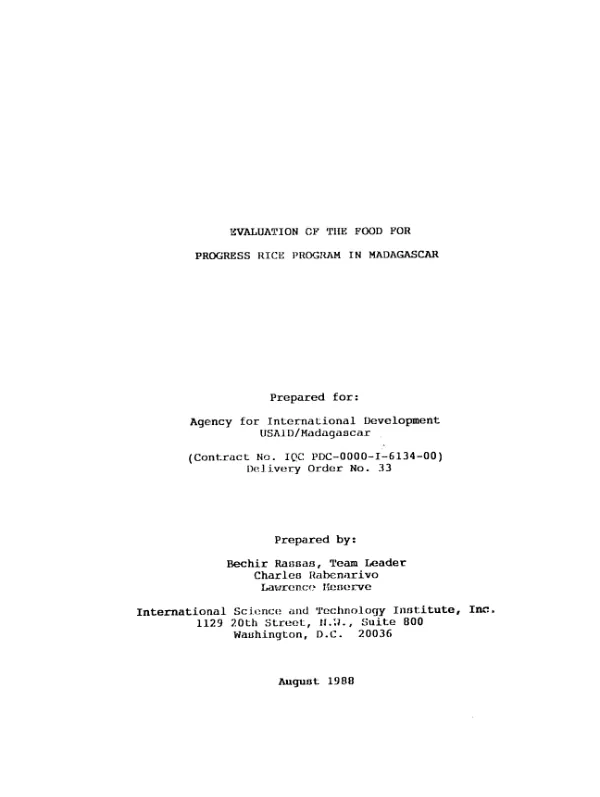
Evaluation of the food for progress rice program in Madagascar
Evaluates Food for Progress program to support rice marketing liberalization in Madagascar by providing a buffer stock to help maintain stable, open-market consumer prices.
Rassas, Bechir|Rabenarivo, Charles|Meserve, Lawrence · 1988
Sign in to readA free account is required to download.
Abstract
External evaluation covers the period 8/86-8/88. Rice was provided only during the first year of the three-year program because good harvests and large carry-over stocks obviated the need for further shipments. As of 7/88, all stocks supplied have been utilized and no further rice shipments have been requested. Physical management of the rice stocks improved considerably after the 1987 evaluation, at which time a strong potential existed for spoilage and/or wastage. Due to improved USAID/M monitoring and efficient measures by local officials, only 4.2% of the total consignment was lost. Success of the buffer-stock price management approach has been mixed. During the 1986-87 lean period, buffer-stock supplies played a decisive role in stabilizing prices. After 1987, however, the buffer stock was sold below market and target prices, indicating that the Government of Madagascar (GOM) inappropriately used the supplies to keep prices low in major urban centers. Also, due to inadequate communication of the buffer-stock target price, traders lacked guidance in making buying and selling decisions; private-sector participation in rice trade has contracted since 1987. Nonetheless, the program has been a significant component of the GOM's overall economic reforms. Progress toward decontrol of rice movement and free market access in the past three to four years has been significant. Regional monopolies on rice distribution have been removed, trade restrictions have been substantially reduced, and the official distribution system was eliminated. As a result, rice mills have flourished, the number of rice assemblers has increased significantly, and competition among traders improved to unprecedented levels. Further, liberalization has resulted in immense benefits to producers without putting an undue price burden on consumers. Several recommendations are made for the benefit of other food aid programs in Madagascar. (1) Appropriate timing of shipments would help overcome local transport, storage, and other logistical constraints. (2) Policy dialogue would be facilitated if the pricing of food commodities, and the timing of their release, were based on more quantifiable criteria. (3) The GOM should be required to submit regular reports providing detailed and consistent information on commodity utilization and an inventory of remaining stocks.