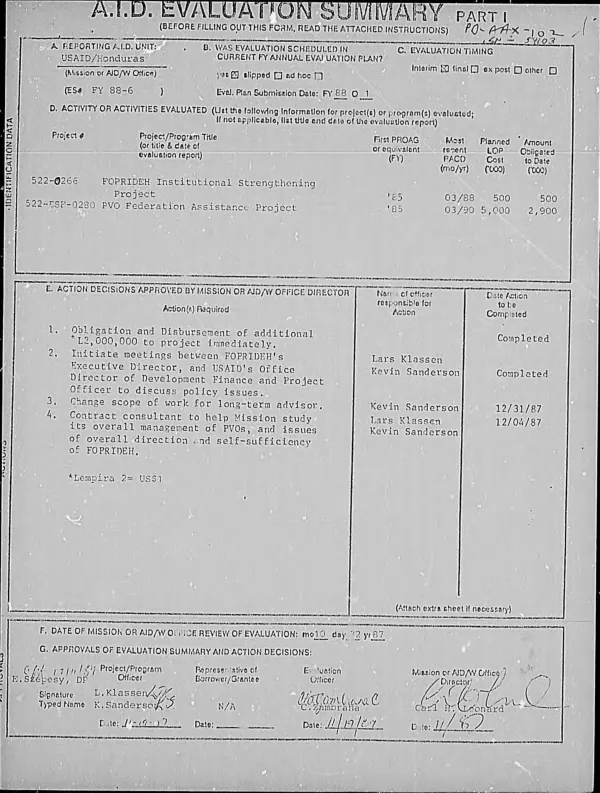
USAID DEC
Evaluation of the Foster Parents Plan child survival II project in Altiplano, Bolivia
Sign inFOSTER PARENTS PLAN, INC.
Evaluation of the Foster Parents Plan child survival II project in Altiplano, Bolivia
Evaluation of a project in Bolivia's Altiplano to conduct child survival (CS) activities, including nutrition education and growth monitoring, diarrheal disease control, and immunization.
Becht, James N. · 1989
Sign in to readA free account is required to download.
Abstract
Foster Parents Plan International (PLAN) is the implementing agency. External evaluation covers the period 1986-8/89. CS interventions have been about 6-12 months behind schedule due to delays in organization and staffing and the time needed to develop a collaborative relationship with the Ministry of Health (MOH). Nonetheless, PLAN has developed very good working relations with the MOH and with other private organizations in the area, and significant progress has been made. Through regular growth monitoring, 81% of children registered under PLAN have maintained a normal weight. Vaccination coverage has also improved, with the percentage of enrolled children receiving all four vaccines before their second birthday increasing from 21% to 52%. Knowledge of oral rehydration therapy (ORT) has increased, with 44% of mothers using ORT salts at home. About half of the target communities now have ORT posts, but the use of these posts has been low (about 1% of estimated diarrheal episodes). For both growth monitoring and immunizations, PLAN has been able to enroll 87% of children 12-23 months but only 49% of those under one year. Coverage of women has been low (30%). PLAN's impact on health conditions is difficult to quantify because several other organizations have been working in the area, the project's objectives were not very well defined, and the existing information system lacks specificity regarding evaluation requirements. Several lessons have been learned. (1) While outside organizations (such as PLAN) can effectively assume a supporting role for community participation, they must make special efforts to allow such participation to emerge from within the community and at the community's own pace. For in the last analysis, only community action can make the program sustainable. (2) The inadequate resources provided to the Ministry of Health in a country such as Bolivia makes it both unrealistic and irresponsible in the short and medium term for PVO's to assume that the Ministry will assume the burden of post-project funding. (3) An information system, preferably one designed at the beginning of the project, plays a crucial role in providing data for project evaluation and monitoring. (4) Service programs are complex and require organization and management if they are to transform available resources into desired results.
![Final evaluation : ADRA [Adventist Development and Relief Agency]/Rwanda -- child survival project : 1985-1989](https://covers.devme.ai/gen/6085.webp)
![Final evaluation : ADRA [Adventist Development and Relief Agency]/Rwanda -- child survival project : 1985-1989](https://covers.devme.ai/gen/47707.webp)