INTERNATIONAL ORGANIZATION FOR MIGRATION (IOM)
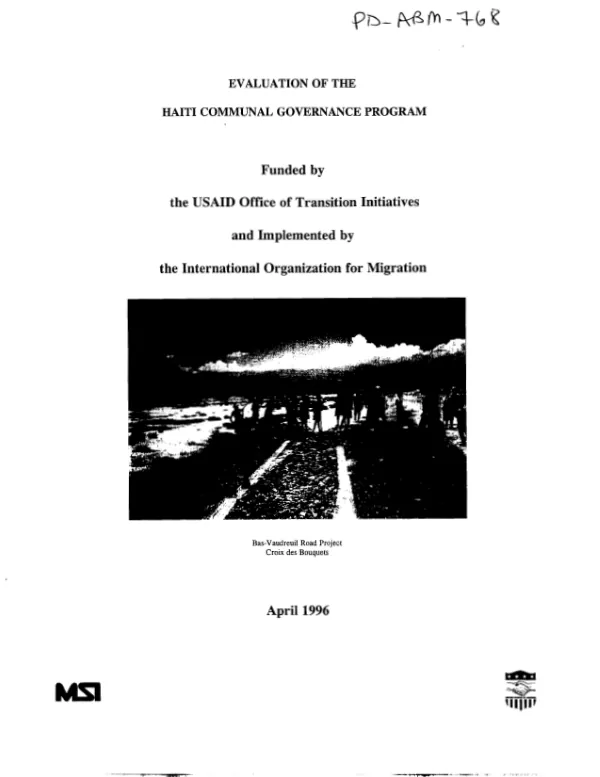
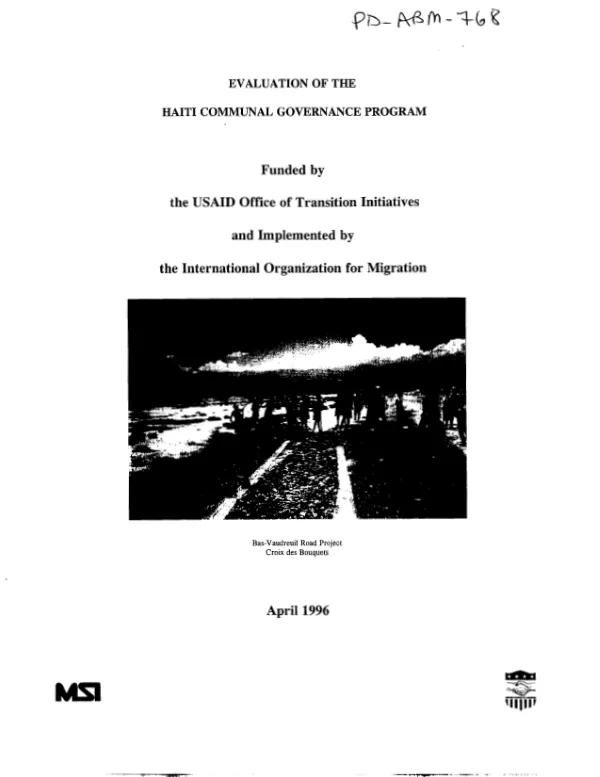
Evaluation of the Haiti communal governance program
Final evaluation of a project (9/94-3/96) to provide rapid, time-limited, and visible assistance to help restore democratically elected government and promote popular political participation in Haiti.
Chandler, Dennis M.|Popper, Roger · 1996
Sign in to readA free account is required to download.
Abstract
USAID's newly established Office of Transition Initiatives (OTI) implemented the project through a cooperative agreement with the International Organization for Migration (IOM) implemented the project. Despite a difficult political and economic situation, both the in-country OTI coordinator and IOM management and field staff have performed with overall excellence, and the project has met its goals and objectives. While the restoration of the Aristide government was brought about primarily by the arrival of foreign troops, the project has supported the democratization process by: quickly providing badly needed material resources to help local organizations begin improving their communities; providing Haitians with a means to express themselves freely with one another and their local representatives; promoting decentralization by working directly with local community groups and local officials; and injecting transparency and accountability into programs and transactions using community resources. Despite initial and well-justified skepticism, the project has initiated an important process of rebuilding confidence in local government and has laid the foundation for further democratization activities. Remarkably, OTI and IOM are providing highly valued assistance to all regions of Haiti and to 113 of the country's 133 counties, engaging more than 2,000 community groups representing some 50,000 Haitians. Although earlier USAID projects had achieved similar geographical spread, this project has been unusual in the variety of projects that it has funded and the speed with which it has moved. Popular reaction to the project's 1,900 micro-projects, particularly Phase I activities (schools, roads, water) has been very positive; the project is uniformly praised for the rapidity of its response to proposals, the absence of hidden personal or political criteria in the micro-project approval process, and its full compliance with all agreements. Micro-projects were equally responsive to men and women, and primarily to children. While there is some tendency for projects to be located in urban sites versus rural ones and along roads and accessible tracks, this seems unintentional and related to management and time considerations. From the planning stage to the on-the-ground operational period, OTI and IOM have closely coordinated their efforts with U.S. and other foreign military. As a result, military and civilian counterparts have shared expertise and complemented each other's efforts. The project is especially profiting from the security umbrella and the logistical and transportation resources of the military. USAID's challenge is to now to build on the project's successes, including the transfer of certain functions to other USAID, Haitian, and/or donor activities. For example, the experience of the Communal Improvement Committees, a temporary mechanism to involve local officials in decisions about the use of funds, should not be lost when the committees disband. The following lessons were learned. (1) USAID should be commended for making adjustments needed for a quick response in Haiti. Its interventions would probably not be feasible for a more typical in-country Mission or where there is no resident Mission. Although OTI should be encouraged to integrate more of its operations with other parts of USAID (and vice versa), it deserves particular recognition for the success of this project. (2) The "notwithstanding" authority in the use of special funding gave OTI an important advantage in speed and flexibility. It should be used elsewhere to expedite the delivery of development assistance. However, OTI should also strive to incorporate more of the sound development criteria and management practices of USAID's traditional operations. (3) The feasibility and utility of military and civilian cooperation in assistance activities was well demonstrated. The military provided transportation and other logistic support to OTI/IOM projects, and their mere presence offered civilian counterparts a security that was vitally important. Such assistance may be essential in similar circumstances before development activities can really get underway and have an impact. In turn, U.S. Special Forces and Civil Affairs units were helped by the financial resources and on-the-ground knowledge provided by the USAID/IOM staff. Such linkages can and should be pursued in other settings where both civilian and military personnel are present. (4) The well-received shift in emphasis from civic education to small projects contains a generic lesson. Democratization efforts in an impoverished setting such as Haiti are effectively pursued through concrete and adequately funded activities yielding tangible benefits. (5) Under conditions of institutional chaos, it is possible for USAID programs to provide resources to local communities without passing through normal channels of the host government. Particularly, where there is either no or weak local government, a multi-faceted approach involving NGOs and government and continued management of funds by USAID is a very useful check on the deficiencies of governmental structures while providing real benefits to the people. Following the evaluation, the project was extended 9 months to 12/96.
Related documents