USAID DEC
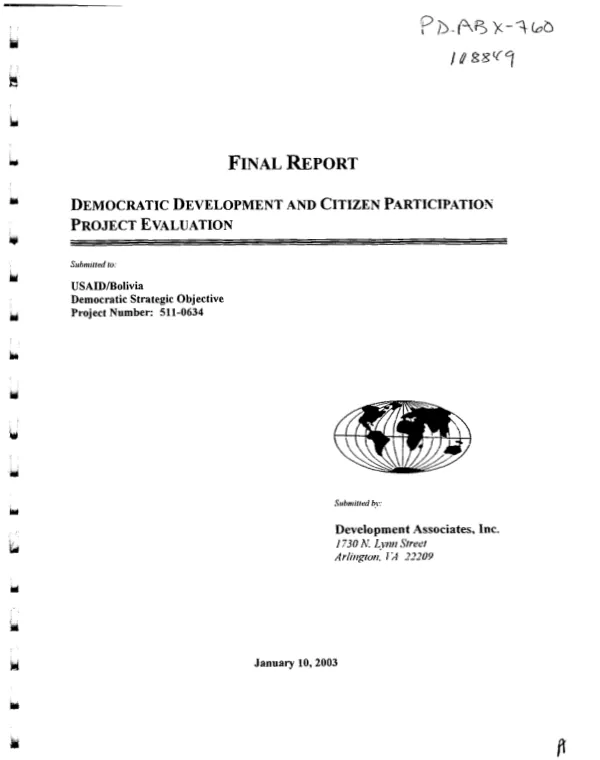
Final report : democratic development and citizen participation -- project evaluation
Sign inDEVELOPMENT ASSOCIATES, INC.
Final report : democratic development and citizen participation -- project evaluation
Final evaluation of Phase II of a project (1994-12/02) to promote democratic development and citizen participation (DDCP) in Bolivia.
2003
Sign in to readA free account is required to download.
Abstract
Chemonics International was the implementing entity. Major achievements are as follows: (1) The project has promoted and popularized citizen participation in democratic processes through the creation of citizen oversight committees and base-level territorial organizations. (2) The DDCP methodology and approach has gained widespread legitimacy at the grassroots, municipal, departmental, and national levels. (3) The project's participatory methodology and approach to strengthening and extending decentralization to the grassroots level has been well accepted and adopted by the Government of Bolivia as policy, and by different donor organizations as a part of their strategy for working with municipalities. (4) The project developed the model of participative municipal management (MGNP), initially through working with 20 municipalities; the approach is replicable nationally. The DDCP has supported and strengthened associations of municipalities and mancomunidades (=voluntary associations of two or more municipalities) at the departmental level, and these are now replicating the model in municipalities. The project provided managerial training and TA to improve municipal authorities' efficiency in implementing and managing infrastructure projects, as well as in providing other municipal services. (6) The integration of gender issues into the overall project methodology and approach has begun. (7) DDCP has been instrumental in establishing two national organizations -- the Federation of Municipal Associations (FAM) and the Association of Council Women of Bolivia (ACOBOL) -- that represent and advocate women's interests in all aspects of governance. (8) The project support fund has been a valuable resource in supporting and strengthening FAM, ACOBOL, associations, and mancomunidades toward sustainable goals to provide services, representation, TA, and consulting services to municipalities and ultimately to local constituents. (9) The project has demonstrated that it is possible to develop a "bottom-up" participatory decentralization activity, even when the policy and laws were "top-down" national initiatives. (10) The project has instilled in the citizenry and the municipal authorities who were trained (29,000) a sense of common responsibility, ownership, and participation in municipal governance. Lessons learned are as follows. (1) The MGNP model was successful because DDCP staff understood that popular participation in developing the model was essential and generated interest, responsibility, and ownership from the participants. (2) With the first 20 communities (1996-99), the participative model was carefully designed as a learning process and was flexible enough to continue evolving in the light of experience. (3) A centralized model for implementing a decentralized project was appropriate for the DDCP. This allowed for creation of a "think tank" of highly experienced and knowledgeable staff at the national level, who developed the model as a group effort through trial and error. (4) DDCP also correctly understood that, besides building the capacity of associations and mancomunidades at the departmental level, there was also a need to support the representation of associations, mancomunidad, and municipal interests at the national level, through the creation of the FAM and ACOBOL. The achievement of DDCP objectives would have been greatly facilitated if the gender integration process undertaken in Phase II had been incorporated into the project from the beginning. (5) Working at the legislative level with the uninominales (=single-member circumscriptions) has been a slower process, partly due to reasons beyond DDCP's control. The role and responsibilities of the uninominales require better definition, recognition, and support from the congress and the executive branch of government. Until this happens, only limited successes will be possible in encouraging uninominales to effectively respond to constituents' demands and needs, as the uninominales have little power and resources within the National Congress.