USAID DEC
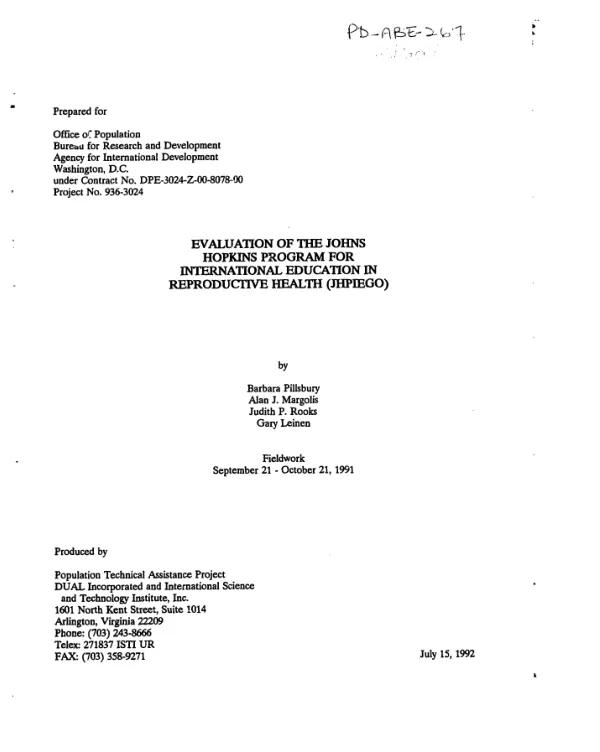
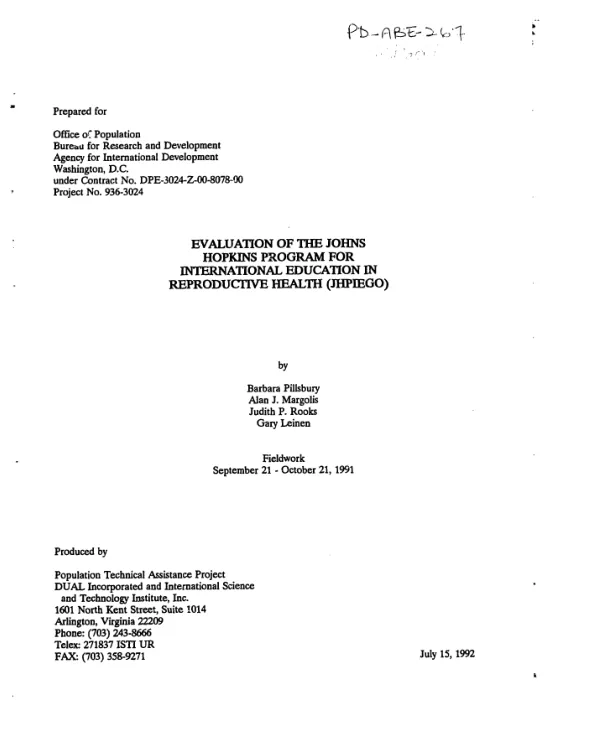
Evaluation of the Johns Hopkins program for international education in reproductive health (JHPIEGO)
Sign inDUAL & ASSOCIATES, INC.
Evaluation of the Johns Hopkins program for international education in reproductive health (JHPIEGO)
Evaluates the Johns Hopkins Program for International Education in Gynecology and Obstetrics (JHPIEGO).
Pillsbury, Barbara L. K.; Margolis, Alan J. · 1992
Sign in to readA free account is required to download.
Abstract
Final external evaluation covers 5/87 to 7/92. PACD is 4/94. JHPIEGO is in the process of a major transition from a program whose dominant components were a Baltimore location, a focus on laparoscopic female sterilization, and training of university- based ob-gyns to a more diversified program with a stronger public health approach to family planning (FP). Excellent progress is being made. Since 1988 JHPIEGO has launched several new initiatives and is uniquely positioned to have an impact in important clinical areas. These initiatives include: standardization of the teaching of manual clinical skills; efforts to make training more efficient; activities to revive the IUD; and development of national clinical standards for training, service delivery, and quality control. Perhaps JHPIEGO"s most significant contribution has been the development of prototype training and reference materials for clinical training in minilaparotomy and management of the copper-T 380A IUD and NORPLANT, along with the development of two reference manuals, one on preventing infection and one on managing genital tract infections,especially in relation to the use of IUD"s. On the negative side, JHPIEGO has not sought to evaluate the overall impact of its work, or even to document it in such a way as to facilitate evaluation by others. Also, development of the above initiatives has largely taken place in the context of in- service training. JHPIEGO has no clear strategy for institutionalizing FP in pre-service education, its efforts in this area frequently being isolated and without either follow- through or documented impact. JHPIEGO has also failed to develop clear strategies for allocating resources across the different components of its program (e.g., training of doctors vs. nurses or midwives). Activities too often flow from historical relationships with leading gynecologists and their institutions. Decisions concerning which countries in which to work and which activities within a country to support are too often made on the basis of targets of opportunity. This may have been appropriate in earlier decades, but is no longer so. Other findings are as follows. (1) JHPIEGO"s management structures are in a state of evolution. Staffing is thin at the leadership level and not adequate to carry out the current program, much less an expanded one. Steps are being taken to hire more people and improve management, but it is too early to predict the outcome. (2) JHPIEGO"s experimental efforts with OPTEL (interactive PC teleconferencing) remain questionable. At this point, OPTEL appears to be primarily a sophisticated technology searching for an application. (3) JHPIEGO"s decreased use of Baltimore training has had mixed results. The regional/international centers supported by JHPIEGO have trained substantial numbers of health care providers and trainers, but JHPIEGO"s limited efforts to evaluate the training provided leave the question of its impact unanswered. Recommendations address the above issues.
Related documents