USAID DEC
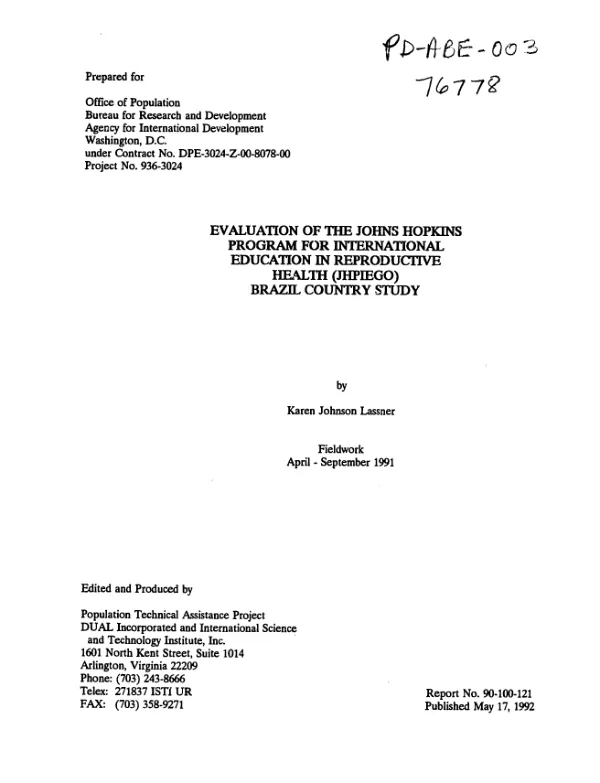
Evaluation of the Johns Hopkins Program for International Education in Reproductive Health (JHPIEGO) Brazil country study
Sign inDUAL & ASSOCIATES, INC.
Evaluation of the Johns Hopkins Program for International Education in Reproductive Health (JHPIEGO) Brazil country study
Evaluation of reproductive health training provided to health professionals in Brazil by the Johns Hopkins Program for International Education in Reproductive Health (JHPIEGO) under four separate projects.
Lassner, Karen Johnson · 1992
Sign in to readA free account is required to download.
Abstract
The evaluation covers the period 1979- 9/91. JHPIEGO's training of more than 5,000 physicians, medical and nursing students, and community health workers over a 12-year period stands as a major accomplishment. Highlights include the following. (1) In-service training at Centro de Pesquisas de Assistencia Integrada a Mulher e a Crianca (CPAIMC), a private family planning provider, made voluntary surgical contraception services available for the first time in Brazil through a private institution, extended services to poorer areas of the country, created clinical sites to use as training laboratories, and introduced the concept that women should have access to all methods in institutional settings. (2) In-service training at BEMFAM, the local International Planned Parenthood affiliate, increased and improved the quality of family planning services provided by physicians and community health workers. JHPIEGO's work also contributed notably to meeting the needs of the country's poorer areas (the Northeast) and integrating family planning into maternal/child health services. (3) Pre-service training resulted in three university-affiliated training centers having curricula that include reproductive health. One area of need not addressed to date has been the training of non-medical staff (social workers, psychologists, etc.). Also, despite its efforts to broaden its image, JHPIEGO remains closely associated with sterilization. JHPIEGO has consistently provided solid administrative support to its projects in Brazil, but due to the small size of JHPIEGO's U.S. headquarters staff, technical support in such areas as curriculum development and clinical backup during training has not always been adequate. Also, JHPIEGO has not developed strong ties with professional medical groups in Brazil, nor has it done as good a job as it might have in cultivating its ties with its own alumni. A new project under negotiation would mark a significant shift in JHPIEGO assistance, since it is designed solely to train public sector personnel. This is in response to the phasing out of A.I.D. assistance to nongovernmental organizations (including assistance to CPAIMC, which risked its own public image by doing pioneering work in sterilization as a result of JHPIEGO training), the development of a new Ministry of Health women's health care program, and JHPIEGO's new emphasis on institutionalization in the public sector. The new project also responds to a considerable need in Brazil, where family planning services are provided almost exclusively by the private sector.