DUAL & ASSOCIATES, INC.
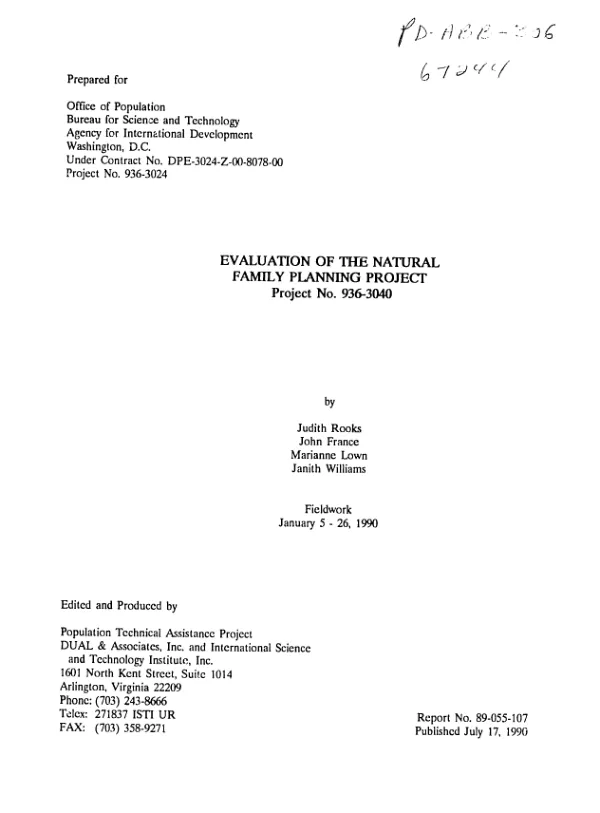
Evaluation of the natural family planning project, project no. 936-3040
Mid-term evaluation of a project to promote natural family planning (NFP) methods through research and educational activities.
Rooks, Judith|France, John · 1990
Sign in to readA free account is required to download.
Abstract
The project is implemented by the Institute for International Studies in Natural Family Planning (IISNFP), a consortium of Georgetown University School of Medicine, the Los Angeles Regional FP Council, and the University of Pittsburgh Graduate School of Public Health. The evaluation covers the period 9/85-1/90. The project is being implemented in a very difficult environment. NFP is a relatively new field, with few experts, weak institutions, and limited absorptive capacity. There are competition and animosity between groups promoting different NFP methods as well as prejudice and hostility against NFP on the part of many mainstream FP agencies. IISNFP, a new institution, had to expend considerable time and energy during the first year in dealing with the political aspects of NFP. Despite these constraints, the project has made considerable progress in several areas. IISNFP has synthesized scientific findings regarding NFP and the lactational amenorrhea contraceptive method and disseminated them to international leaders in maternal/child health/FP in a manner which has earned respect; that the synthesis was produced by respected medical schools was an important factor. IISNFP has also helped unify the NFP community by taking a moderate stand on divisive issues and be developing and guiding processes enabling people of different opinions to work together constructively. The project has produced an NFP trainer's manual and provided high-quality regional courses for 59 NFP instructors who in turn have trained at least 1,200 additional instructors. Most training efforts have focused on NFP-only service providers (primarily associated with the Roman Catholic Church), while relatively little work has been done to incorporate NFP into multi-method FP services. IEC activities have extended beyond the church and the health care system and included projects to reach women enrolled in home economics courses in the Ivory Coast and to use mass media and community events to reach women in Peru. Although work on breastfeeding did not start until early 1988, it has become a significant part of the project. IISNFP acts as secretariat for the Interagency Group for Action on Breastfeeding (IGAB), a coalition of technical staff from UNICEF, WHO, SIDA, and A.I.D. IGAB has convened several important technical meetings and, focusing on Latin America, has promoted breastfeeding as a contraceptive method in various ways -- developing a breastfeeding curriculum for nursing schools, evaluating breastfeeding interventions in three countries, and promoting breastfeeding among the Indians of Cuzco, Peru, through radio programs, community activities, and training for health professionals and policymakers. Research activities, which comprise about half of project efforts, are not yet completed. Biomedical studies in progress relate to the physiology and endocrinology of a woman's fertile period, the development of a home test kit for determining fertile days, the fear that NFP may result in defective fetuses, and the extent to which breastfeeding women can use NFP methods to detect their first postpartum ovulation. Several operations and social science research projects are also underway. The project has not, however, given sufficient attention to field trials to measure the rates of effectiveness and continuation with various NFP methods or to behavioral studies related to periodic abstinence.
Related documents