USAID DEC
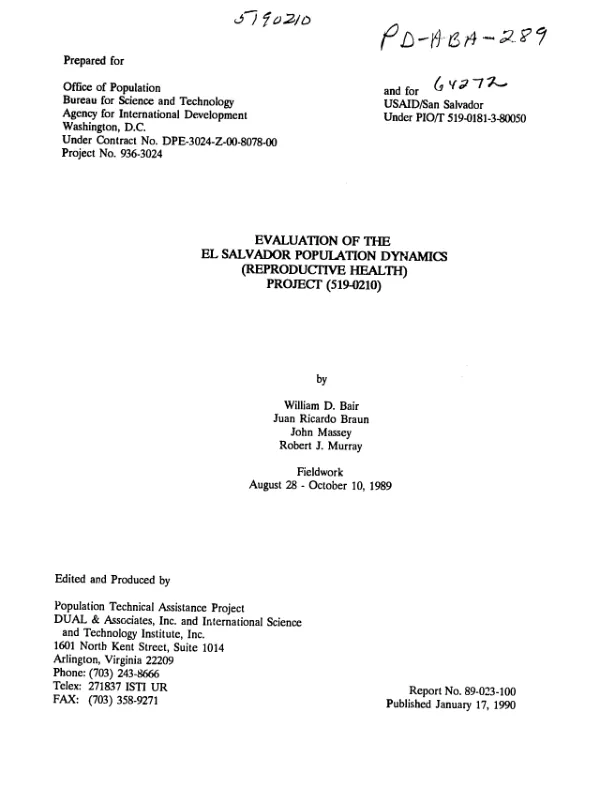
Evaluation of the El Salvador population dynamics (reproductive health) project (519-0210)
Sign inDUAL & ASSOCIATES, INC.
Evaluation of the El Salvador population dynamics (reproductive health) project (519-0210)
Interim evaluation of a project to improve the delivery of family planning services in El Salvador by providing TA to involved Government of El Salvador (GOES) institutions in the areas of administration, training, IEC, information management, and policymaking.
Bair, William D.|Braun, Juan Ricardo · 1990
Sign in to readA free account is required to download.
Abstract
The evaluation covers the period 8/85-10/89. Although substantial progress was made in each component, overall achievement was constrained by extremely difficult political and economic conditions. The project also suffered from administrative problems in maintaining an adequate flow of funding and assuring timely procurement of goods and services. This was due primarily to a complex administrative arrangement between A.I.D., involved GOES institutions, and SETEFE, the GOES organization that coordinates foreign assistance. Training of generally acceptable quality was provided to 20% more personnel than targeted. However, more attention could have been given to rural health aides, doctors in their initial year of service, and graduate nurses; course design could have been more closely linked to specific jobs; and more emphasis could have been placed on curricula validation. An effective mass media campaign reached nearly 4 million persons. Unfortunately, some of the impact of this campaign was lost due to a delay in implementing a companion interpersonal communication campaign. The management information system has been effective in improving the distribution and warehousing of contraceptives. In addition, its capabilities have been expanded to include service delivery information that measures progress in terms of couple years of protection. Success has not been achieved in improving maintenance of medical equipment, primarily due to procurement problems, possibly compounded by less than adequate commitment to concepts of preventive maintenance. Although a national population policy was adopted, efforts to disseminate this policy and to develop a population data bank have lagged. Several lessons were learned. (1) Projects involving institution building and developing the capability to conduct coordinated planning should anticipate at least a five-year time frame. (2) Complicated bureaucratic structures should be avoided. (3) TA should be provided through a close, day-to-day working relationship with identified counterparts. (4) Attention to monitoring programmatic functions should equal that given to fiscal matters. (5) To achieve changes in service delivery, training must be provided to doctors and nurses as well as to lower-level service providers. (6) Interpersonal communication campaigns require more resources than mass media campaigns. (7) A computerized logistics management system can be effective in improving contraceptive supply as well as in providing a service statistics system that can be operated by service point staff.