INTERNATIONAL SCIENCE AND TECHNOLOGY INSTITUTE, INC. (ISTI)
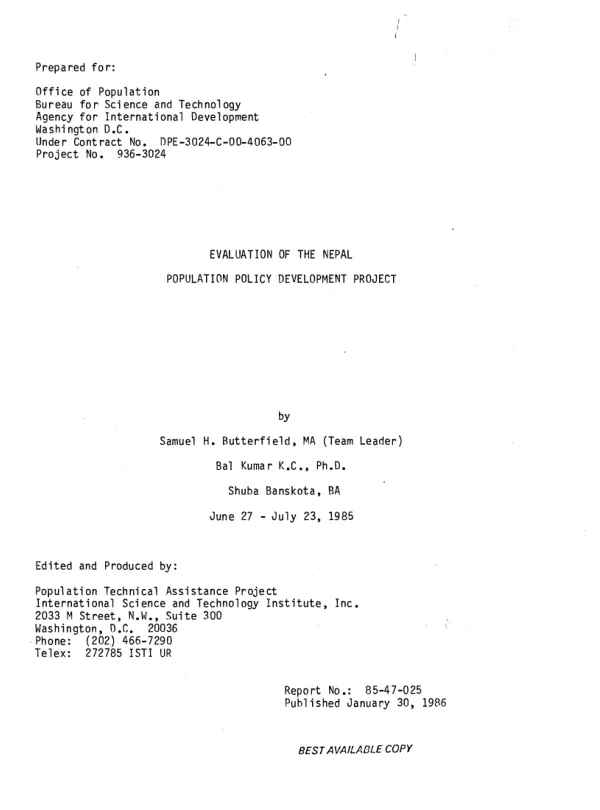
Evaluation of the Nepal population policy development project
Evaluates project in Nepal to promote the institutional development of the National Commission on Population (NCP) and to support the development of a national population policy.
Butterfield, Samuel H.|Kumar, Bal|Banskota, Shuba · 1986
Sign in to readA free account is required to download.
Abstract
External end of project evaluation covers the period 1979-7/85 and is based on document review and interviews with officials of the NCP, His Majesty's Government (HMG), and with other donor representatives. The project has been in decline since mid 1983, but before then made useful progress in a number of areas. The most significant accomplishment was NCP's lead in the government-wide population planning process, which culminated in an ambitious, but feasible, National Population Strategy aimed at reducing Nepal's total fertility rate to 2.5 by the year 2000. A number of other activities were undertaken, including vigorous pursuit of research projects (43 research studies and major reports were carried out) and dissemination of information about population through publications and seminars. The NCP's capacity to manage the research process grew steadily and over time the studies themselves became less theoretical and more relevant. Participant training has been successful. Thirty persons will have received training abroad; all who have completed their studies have returned to Nepal and all but one are using the knowledge they gained in their work. The project's inclusion of participants from private, nonprofit research organizations and from junior professional ranks of government is unusual in Nepal, reflecting useful managerial initiative by the NCP. Strong support at the highest levels of HMG was a critical component of the project's successes, especially in formulating a population strategy. The support ceased, however, with a change in political leadership, and the current HMG leaders have tended to ignore the NCP. The downturn of project activities began in mid-1983 as a result, and at present both NCP institutional strength and implementation of population strategy have waned. The project teaches that while much can be accomplished in a relatively short time by focusing assistance on key development policy issues, policy accomplishments are fragile, dependent on continued active support from top political leaders. Proposals have been made to transfer the NCP's training and basic research functions to a new organization, which would take over operations research and policy-related research while assuming all public information functions. These proposals would seriously weaken the NCP. Nine recommendations provided instead address revitalization of the NCP and its political base.