USAID DEC
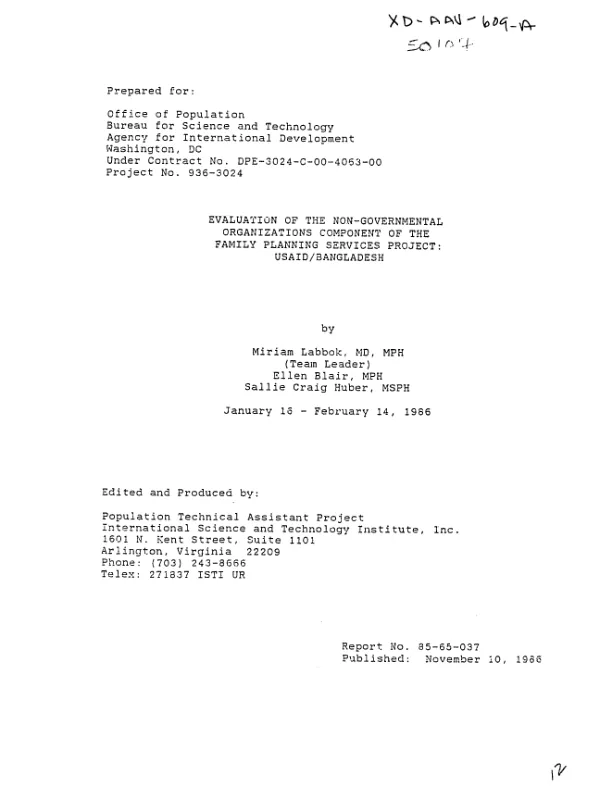
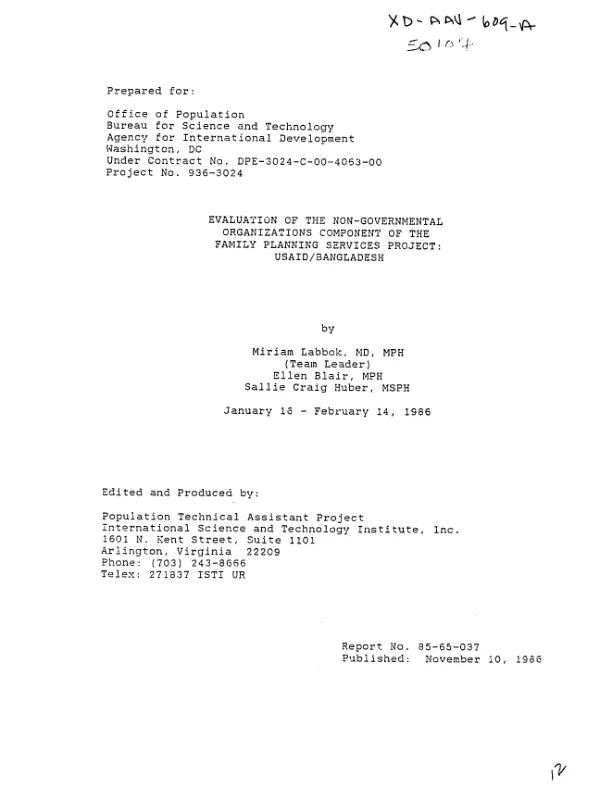
Evaluation of the non-governmental organizations component of the family planning services project USAID Bangladesh
Sign inUSAID. MISSION TO BANGLADESH
Evaluation of the non-governmental organizations component of the family planning services project USAID Bangladesh
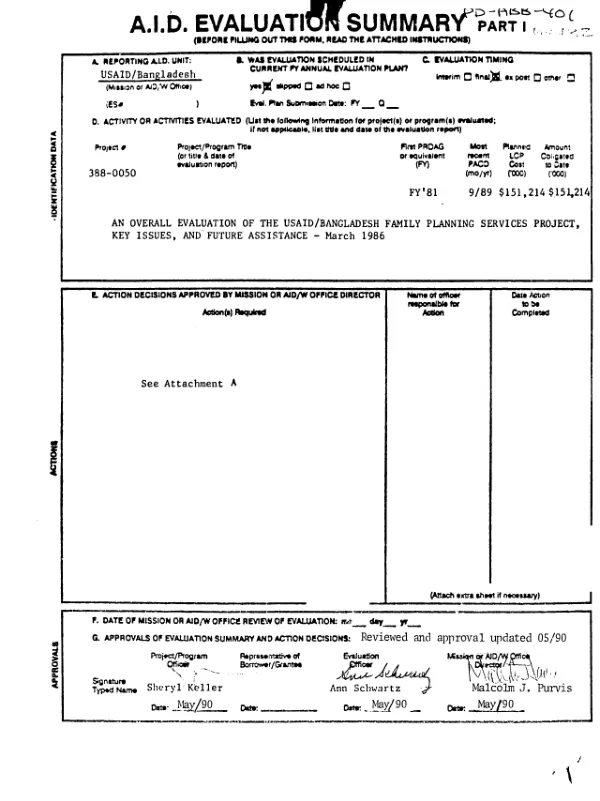
Summarizes attached external evaluation (XD-AAV-609-A) of a project component to support the family planning (FP) services of nongovernmental organizations (NGO"s) in Bangladesh.
1986
Sign in to readA free account is required to download.
Abstract
Evaluation covered the period 1981-2/86 and was based on document review, site visits, and interviews with NGO and Government of Bangladesh (BDG) personnel. Overall, the NGO program is functioning well. As of 8/86, six NGO"s had initiated 81 subprojects (SP"s) at 297 sites, covering 75-80% of Bangladesh"s municipal areas. FP services have increased by 11% since 1981, and as of 1985 the six NGO"s were providing contraceptives to 25% of users nationwide. NGO success in reducing fertility in urban and semi-urban areas has led the BDG to lift its ban on NGO operations in rural areas. FP cost-effectiveness has improved in the older, more mature NGO"s. The Bangladesh Association for Voluntary Sterilization program is the most cost-effective, but does not offer alternative methods to those ineligible for voluntary sterilization. NGO training needs - at all levels - have outstripped the capacity of the BDG facility mandated to respond to these needs. As a result, the NGO"s, which have been providing most of the training themselves, recently formed a coordinating training committee. With the difficult task of serving rural areas about to begin, key needs are to strengthen and standardize administrative oversight by USAID/B and the NGO"s and to streamline management generally. Consolidation of numerous SP"s, a lengthened planning and budgeting cycle, and a much improved logistics and supply system have reduced management burdens to some degree, but improvements are still needed. major problem, for example, and there are still some gaps and overlapping of services (both FP and maternal/child health - MCH) in urban areas. Also, relationships between central staff and fieldworkers (often volunteers) need improvement. The NGO"s also need to: improve follow ups, especially of IUD users; standardize SP selection criteria; improve coordination with the BDG; and increase data collection to help in developing innovative FP delivery mechanisms. The project shows that: (1) NGO"s can provide effective, well-managed community-based FP and MCH services and contribute to BDG fertility reduction goals, given conscientious monitoring by NGO and USAID staff; (2) innovative pilot SP"s can thrive in resource-poor countries when all involved agencies work together toward a common goal; (3) volunteer staff, in addition to cutting costs, can provide evaluative feedback and contribute to NGO policy; and (4) diverse NGO needs can be met through perceptive planning and coherent development strategies.
Related documents
![FPAK [Family Planning Association, Kenya] CBD [community-based distribution] program evaluation](https://covers.devme.ai/gen/67095.webp)
![FPAK [Family Planning Association, Kenya] CBD [community-based distribution] program evaluation](https://covers.devme.ai/gen/7856.webp)