USAID DEC
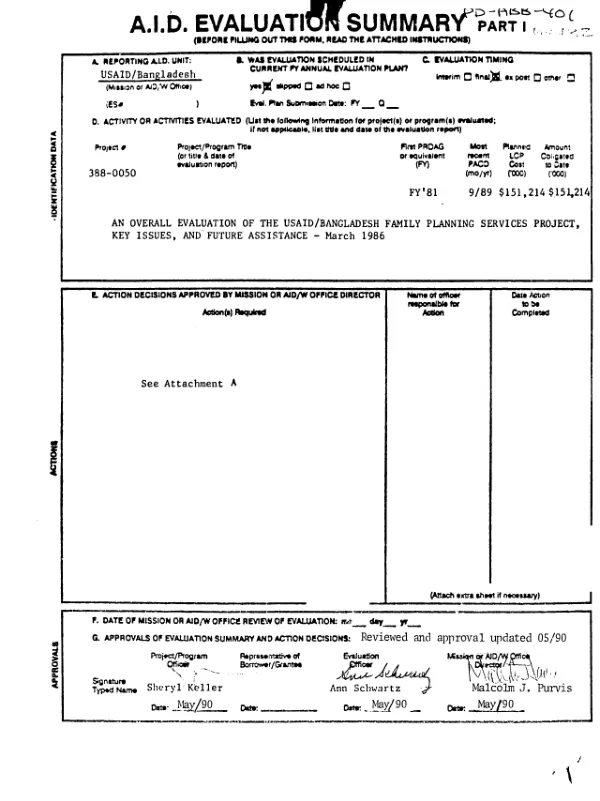
Overall evaluation of the USAID/Bangladesh family planning services project : key issues, and future assistance, March 1986
Sign inUSAID. MISSION TO BANGLADESH
Overall evaluation of the USAID/Bangladesh family planning services project : key issues, and future assistance, March 1986
Summarizes final evaluation (PD-ABB-089) of a project to increase contraceptive use in Bangladesh by supporting involved governmental and nongovernmental agencies and strengthening the country"s contraceptive social marketing system.
1990
Sign in to readA free account is required to download.
Abstract
The evaluation covered the period FY81-3/86. The project made significant progress in several areas. Contraceptive procurement, storage, and distribution were improved; access to and use of voluntary sterilization (VS) increased significantly; NGO activity greatly expanded; social marketing retail outlets increased sales of all methods (with the exception of a slight decrease in condom sales in 1985); and high-quality, policy-relevant research was performed on the impact of FP and fertility on maternal/child health. Despite these achievements, it is unlikely that the project goal of a modern method contraceptive prevalence rate of 28% will be achieved by 1987. This is primarily due to a recent decline in VS procedures without a corresponding increase in other methods. While 80% of the increase in contraceptive use from 1979-83 was due to VS, this method accounted for only 40% of the increase during the 1983-1985 period. An apparently growing number of couples prefer non-permanent methods. The project is also constrained by the inability of a significant number of women to obtain FP services outside their home village. A 1980 decision by the Government of Bangladesh to integrate health and FP services also created problems, particularly with regard to worker morale. No notable efforts were made to decentralize the administration of health and FP service delivery. Several lessons were learned. (1) Substantial increases in modern contraceptive use can occur without economic and social change. (2) Declines in fertility appear to contribute to lower neonatal, child, and maternal mortality. (3) Prior to introducing new services, it is important to determine whether the service providers can absorb the additional workload. (4) The most effective way of reaching rural Bangladeshi couples with basic health and FP services is through home visits by trained female workers.