USAID DEC
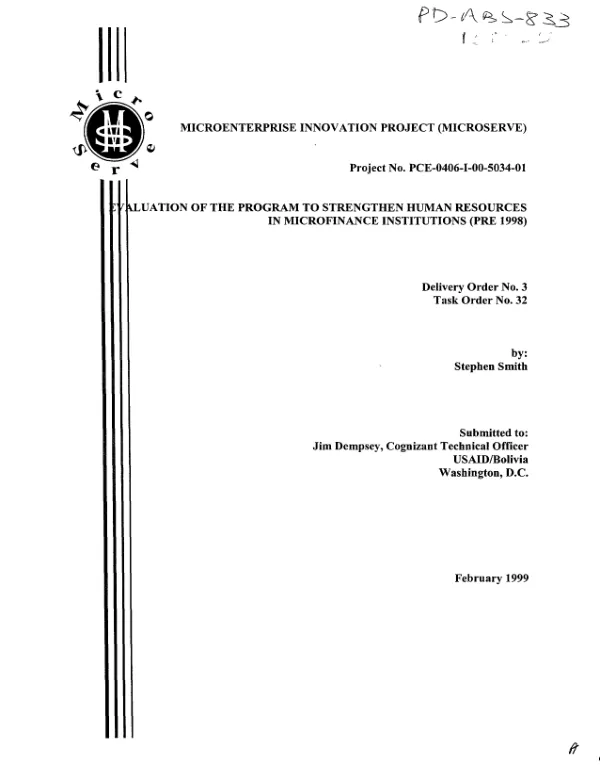
Evaluation of the program to strengthen human resources in microfinance institutions (PRE 1998)
Sign inCHEMONICS INTERNATIONAL, INC.
Evaluation of the program to strengthen human resources in microfinance institutions (PRE 1998)
Evaluates PRE -- the Program to Strengthen Human Resources in Microfinance Institutions, Bolivia's first effort to institutionalize microfinance training.
Smith, Stephen · 1999
Sign in to readA free account is required to download.
Abstract
Interim evaluation covers the year 1998, the program's pilot year of implementation. PRE received financial and material support from La Fundacion para la Produccion (FUNDA-PRO), USAID, and Plan International (PLAN). It was administered by the Bolivian Institute for Business Studies (IBEE) and accredited with diploma status by the Catholic University. Interviews with PRE students revealed a high opinion of PRE's program structure and academic content. Because the 22 students varied greatly in their educational backgrounds and professional responsibilities, not all courses were appropriate to all students. In the future, PRE organizers should consider offering electives as well as the required core courses. All the students were pleased that PRE had provided them with knowledge and practical tools, which they apply in their jobs. According to students, the quality of instructors was, with a few exceptions, similarly high. The quality and effectiveness of teaching methodologies and materials varied among courses. Efforts to prevent this in the future should be made through a more pro-active role by PRE staff in: choosing instructors; providing them guidance on curricula, teaching methodologies and materials, and requiring instructors to provide detailed information in these same areas; and providing feedback to instructors in developing their teaching programs. Students expressed a strong preference for practical training exercises as opposed to theory. They also learned a great deal by interacting with their student colleagues. These facts should be considered in designing future programs. The involvement by multiple institutions and individuals in assuring a successful PRE 1998 may have inadvertently detracted from the institutionalization process. PRE organizers compensated for IBEE's lack of technical capacity in microfinance by hiring an outside consultant to act as PRE coordinator. They also became involved in technical issues themselves. Furthermore, roles, responsibilities, and reporting relationships were not clearly organized and defined among these institutions and individuals. This led to misunderstandings and significant tension among parties, especially between the PRE coordinator and IBEE's general manager. Problems such as these should be avoided in the future by taking an institutional approach towards implementation and by clearly defining roles and lines of authority and communication. According to students, the only major problem with PRE 1998 was the frequent changes in dates and instructors. This problem worsened as the program progressed, and left a negative overall impression of PRE with a few of the students. Although many of the changes may not have been entirely preventable, efforts in the future can be made to limit them by: (1) securing more definitive commitments from instructors, (2) arranging for alternate instructors, and (3) announcing course dates and instructors on a semester or trimester basis. IBEE and the PRE Coordinators carried out the logistics for individual courses adequately. The IBEE secretary, in particular, was successful in maintaining open lines of communication with and providing excellent service to the students. The IBEE classroom, complained students, was small and uncomfortable. Alternative classroom settings should be considered for future programs. IBEE implements a wide variety of business courses, apart from PRE, with a small staff of seven. The functions of the two professional staff members are mostly administrative. They lack the professional qualifications to manage a sector focused business-training program. For IBEE to competently manage PRE in the future, two major decisions are necessary: (1) the prioritization of microfinance among IBEE's principal institutional goals, and (2) the strengthening of IBEE's leadership and microfinance capacity. (Author abstract, modified)
![Plan International : credit/MED [credit and microenterprise development] institutional strengthening initiative -- mid-term evaluation](https://covers.devme.ai/gen/5603.webp)
![Plan International : credit/MED [credit and microenterprise development] institutional strengthening initiative -- mid-term evaluation](https://covers.devme.ai/gen/32318.webp)