CHEMONICS INTERNATIONAL, INC.
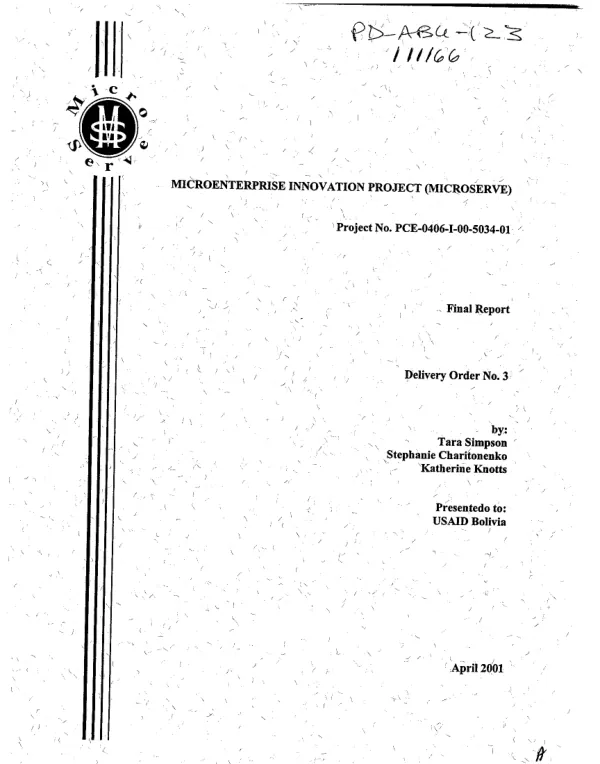
Microenterprise innovation project (MICROSERVE) : final report
Final report of Chemonics on the Microserve IQC (indefinite quantity contract), a TA and training component (9/95-3/01) of the Microenterprise Innovation Project (MIP).
Simpson, Tara; Charitonenko, Stephanie +1 more · 2001
Sign in to readA free account is required to download.
Abstract
Over the life of the MicroServe IQC, a total of 13 task orders (TOs) were awarded, 6 by USAID/Washington, 7 by Missions in Bangladesh, Bolivia, Mali, Madagascar, Mexico, Sri Lanka, and West Bank/Gaza. Under the 13 TOs, more than 150 delivery orders (DOs) were carried out for TA services or conferences/training support, and over 100 publications were produced on various microenterprise development topics. The bulk of the DOs (around 114) were implemented in Bolivia under TO 3, and focused on specific TA and training activities to assist the development of Bolivia"s microfinance market. Details on this assistance are provided in the report. The efforts of Chemonics have assisted the expansion and maturation of microfinance institutions (MFIs) in Bolivia and helped the country gain international recognition for having one of the most developed microfinance markets in the world. Besides providing focused TA and training to seven of Bolivia"s leading MFIs, Chemonics has helped create and maintain an enabling environment for microenterprise development by working with the Superintendency of Banks and Financial Entities (SBEF) and the Vice Ministry of Financial Affairs (VMF) on policy, legal, regulatory, and supervisory issues relevant to the sector"s growth. Over the life of TO 3 (5/96-3/01), Chemonics facilitated the transformation of three NGOs to Private Financial Funds (FFPs) -- FIE in 1998, EcoFuturo in 1999, and Prodem in 2000. Chemonics also helped Agrocapital transform itself from an NGO to an FFP, although Agrocapital had yet to receive its FFP license. Through TO 3 Chemonics also supported domestic and international training for microfinance practitioners while building local institutional capacity to continue such training; and assisted in improving the policy and legal framework for the sector, especially in the areas of prudential regulation, self-regulation, supervision procedures, credit information gathering and reporting, crisis management, and financial tax codes. This combination of TA and training helped Bolivia"s leading MFIs weather one of its biggest challenges -- the consumer debt crisis of 1997-98 -- to emerge stronger and able to achieve the best performance to date in terms of financial self-sustainability and outreach. Despite the rapid growth of Bolivia"s microfinance sector for most of the 1990"s, it has become increasingly clear that MFIs have saturated the urban market and are experiencing heightened competition. Due to increased overall microfinance market commercialization and crowding, further improvements in MFI performance will require additional innovations by practitioners to better meet their clients" needs in more cost-effective ways. By expanding into rural markets, developing more diverse financial products, and utilizing new technologies to lessen the costs of financial service delivery, Bolivia"s MFIs should be able to achieve greater financial self-sustainability while increasing both the breadth and depth of their outreach. To this end, in March 2001 USAID/Bolivia awarded Development Alternative, Inc. (DAI) a 4-year TO under the financial services component of the Support for Economic Growth and Institutional Reform (SEGIR) Results Package IQC, in large part to continue the expansion of Bolivia"s microfinance market into rural areas and sustainably increase the overall level of savings mobilization. (Author abstract, modified)
Related documents
![Implementation of USAID/Mexico microenterprise strategy : results framework progress report[ -- first annual report, November 2000-December 2001]](https://covers.devme.ai/gen/49191.webp)