CREATIVE ASSOCIATES INTERNATIONAL, INC. (CAII)
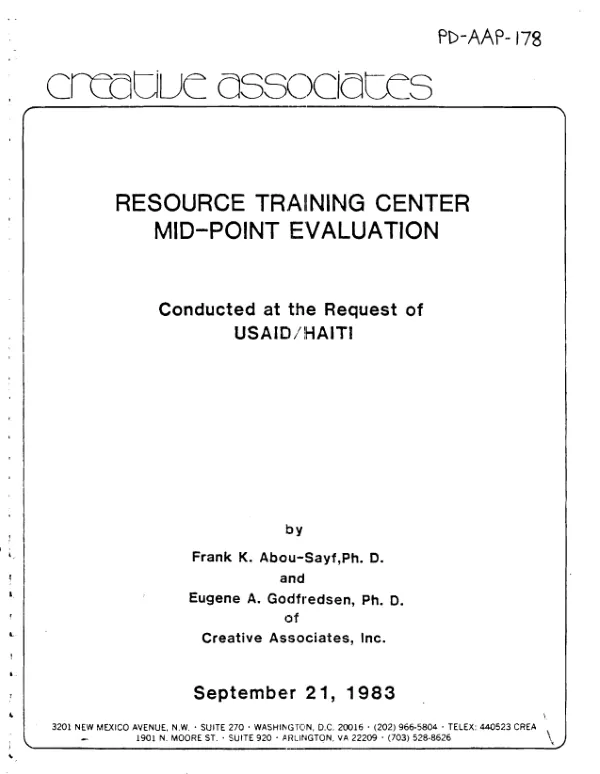
Evaluation of the project de developpement communautaire de Chambellan, PDCC
Evaluates an integrated rural development project consisting of 23 activities in the commune of Chambellan in Haiti.
Locher, Uli · 1984
Sign in to readA free account is required to download.
Abstract
External evaluation covers the period through 6/84 and is based on document review, interviews with project personnel and beneficiaries, and a sample survey of commune residents. Although the project's implementation approach raises serious issues regarding community participation and empowerment, social costs, and distribution of benefits, its achievements are quite respectable. Twelve components have reached or surpassed targets. Major infrastructural improvements have included construction of a potable water system for Chambellan and adjacent communities and of a slaughterhouse. Agricultural activities have had the highest rate of success and included training animators to work with farmers in vegetable gardens, organizing the distribution of tools and seeds, establishing nurseries, establishing 2 co-ops, and training in animal husbandry. Most educational activities have been well done; major accomplishments have been refurbishing the national school and the formation of women's interest groups. Other achievements include a nutrition program and constructing 12 (vs. 5 planned) social centers. The problems experienced in other activities were often the result of inadequate feasibility studies and/or overambitious planning. Two planned activities were cancelled and another - involving the costly procurement and installation of a hydroelectric turbine unit - was totally inappropriate. Several activities (latrine building, teacher training, and dispensary construction) failed because the community refused to participate without payment (which was not entirely unjustified as much infrastructure work was done on a paid basis, in which professionals were hired and, in turn, paid their workers). While the project has to a degree stimulated peasant group formation, it has also - and to a much greater degree - strengthened the local political hierarchy (i.e., the community councils and their groupements). In many instances, community councils have coerced the poorest and weakest community members to "donate" labor for project activities of which they (council members) are the chief beneficiaries. The project's economic benefits have indisputably been skewed toward the wealthier population segment. Recommendations include to: undertake fewer activities, focusing on those that will most benefit peasants, and on the areas of agriculture and agricultural research, environmental protection, and education of children; reduce reliance on the councils as much as possible; and not expect unpaid community labor.
Related documents