USAID. MISSION TO BOTSWANA
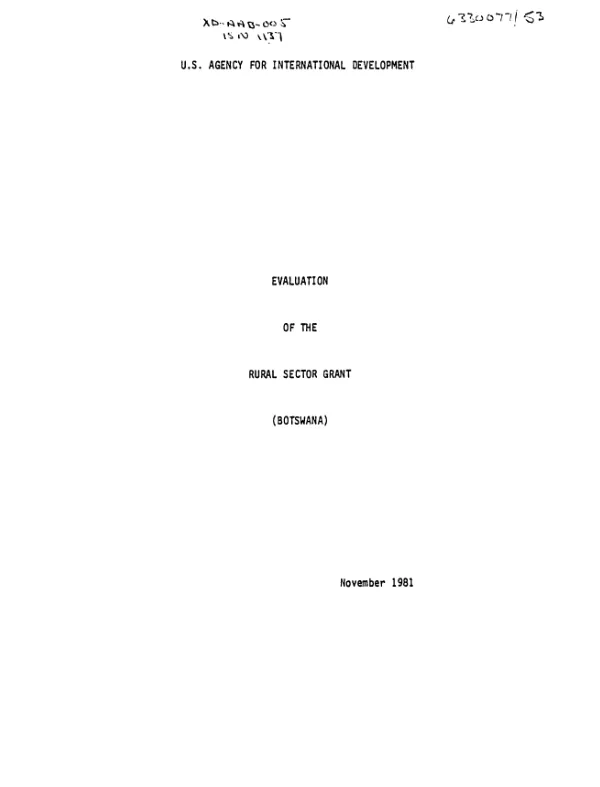
Evaluation of the rural sector grant
Evaluates project to assist the Government of Botswana (GOB) to raise rural employment, production, and incomes and to improve rural land use.
1981
Sign in to readA free account is required to download.
Abstract
Special evaluation covers the period 6/80-10/81 and is based on site visits. While still in the early stages of implementation, the project is beginning to influence GOB planning, promote valuable high-risk endeavors, and develop institutions which will favorably affect rural employment. Further, the project has contributed somewhat to administrative decentralization and has successfully melded several separate activities. In the area of local land use planning and management, some headway has been made in training, especially for Land Board Technical Assistants. However, the GOB Ministry of Local Government and Lands (MLGL) has had difficulty identifying trainees. Two key MLGL personnel should be returning with U.S. M.S. degrees soon. The MLGL applied research unit is fully functional and should begin to analyze land tenure issues in the third year. Four districts are in the process of developing communal area land use plans, and the results of Cornell University's water points survey have been distributed and are expected to be incorporated into water use planning. In terms of raising farm production and income, pilot subprojects have included: improved, mechanized, technical crop production packages; construction of water catchment tanks; purchasing of draft animals; and erection of fences to protect cultivated land. Most subprojects have been successful and have spurred interest in adjacent villages. Also, the ability of Ministry of Agriculture staff to work with projects has been strengthened. Regarding generation of non-farm employment, the establishment and performance of a cadre of rural industrial officers (RIO's) consisting of Peace Corps and other foreign volunteers has been timely and efficient. Setting up small project funds at the local level has been a quick and efficient means of providing concrete assistance (e.g., training, tools, surveys), thus lending credibility to the RIO's. However, lack of understanding of the local resource base has been a constraint. Numerous recommendations are provided inter alia.