USAID DEC
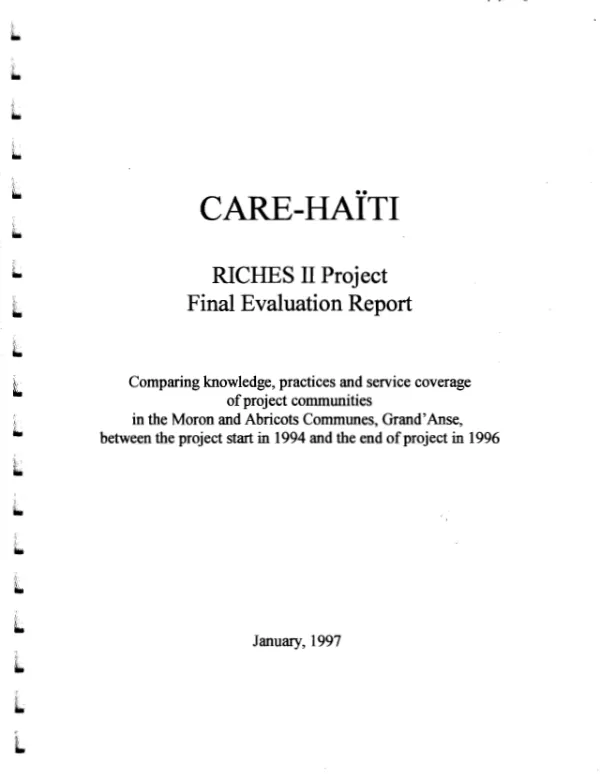
Evaluation of the second part of the resources in community health education support project (RICHES II)
Sign inUSAID DEC
Evaluation of the second part of the resources in community health education support project (RICHES II)
Final evaluation of Phase II of CARE's Resources in Community Health Education Support Project (RICHES II) (9/93-9/96), a community-based child survival (CS) program for isolated communities in Haiti.
O'Rourke, Shelagh · 1996
Sign in to readA free account is required to download.
Abstract
RICHES II was preceded by RICHES I (1989-93) and by Community Integrated Nutrition and Education Centers Outreach (CINECO -- 1985-88). Over the past decade, CARE's CS projects in Haiti have become less widely disbursed and more regionally consolidated, increasingly focused on community involvement and control, and less involved in direct service provision and more in the provision of technical and managerial assistance. Although the projects have often been criticized for their relatively high cost per capita, they have probably expended at least as many resources developing appropriate CS technologies and models for Haiti as they have for service delivery. The results of these expenditures are: (1) an acclaimed health education package for persons with low or no literacy that has been adopted by many other health organizations; (2) a community-based family planning model that has produced possibly the nation's highest rural contraceptive prevalence rate and which is being assessed for replication; and (3) a sexually transmitted diseases and AIDS prevention program that has probably achieved the highest knowledge levels nationally. In RICHES II, which was implemented in 263 isolated western Grand Anse localities, CARE/Haiti collaborated with the Ministry of Public Health (MSP) and key NGOs to develop community-based human resources to promote and carry out a diverse menu of services: immunizations, oral rehydration therapy promotion, growth monitoring and promotion, screening for high-risk pregnancy, vitamin A and iron supplementation, community-based contraceptives distribution, and health and family planning education. Beneficiaries totaled 37,000 women and children for basic CS activities, and 33,000 women and men for FP activities. Although immunization coverage was much lower than planned, the project's educational package was highly touted. In addition, the project's staff are highly trained and motivated, and community participants are generally knowledgeable health service consumers who display many positive health seeking behaviors at significantly higher levels than the national average. Since RICHES II communities are not yet ready to assume responsibility for continuing CS services, the Haitian Health Foundation (HHF) has proposed to take over the catchment area currently served by the project. The MSP and the donor community should be made aware, however, that if the HHF does not assume this responsibility, these communities, on which so many resources have been expended and in which so much has been achieved, will be abandoned. It is recommended that CARE/Haiti, given its past achievements in developing success models for rural preventive health care, develop a community devolvement model as its next major CS task. (Author abstract, modified).
Related documents
Documents in this collection
 2000
2000USAID DEC
CARE-Mozambique : final evaluation -- child survival XII : improving maternal and child health in rural communities of Nampula Province : September 30, 1996 to September 30, 2000 -- FAO-A-00-96-90040-00
Open record 2000
2000USAID DEC
![Midterm evaluation for the period of November 1994 - August 1996 -- final report : child survival activities in Haiti -- integration of sustainable child survival interventions into the mission of CRUDEM [Center for Rural Development of Milot], a private sector organization in the Department of the North, Haiti](https://covers.devme.ai/gen/6090.webp)
![Midterm evaluation for the period of November 1994 - August 1996 -- final report : child survival activities in Haiti -- integration of sustainable child survival interventions into the mission of CRUDEM [Center for Rural Development of Milot], a private sector organization in the Department of the North, Haiti](https://covers.devme.ai/gen/65690.webp)