DATEX, INC.
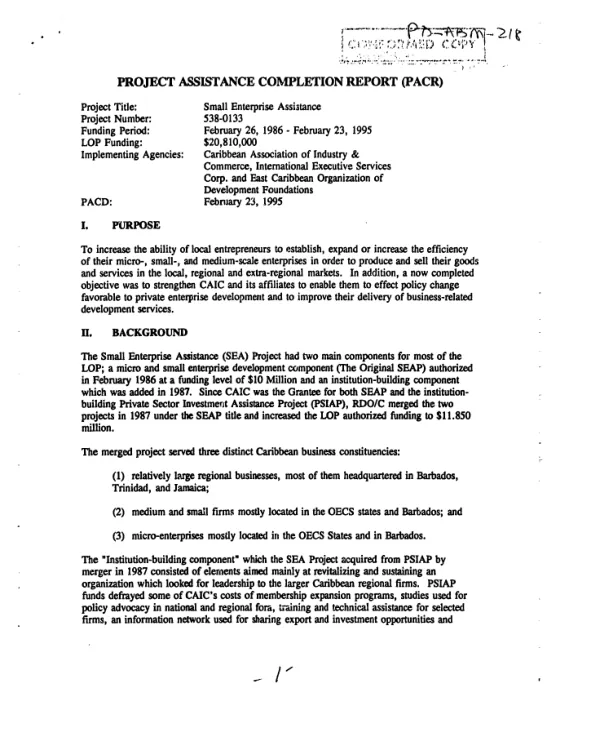
Evaluation of the small enterprise assistance project : project no. 538-0133
Final evaluation of a project (2/86-9/95) to support the development of microenterprises in the Eastern Caribbean by supporting National Development Foundations (NDFs) and their microenterprise activities, coordinating TA to small and medium-scale enterprises (SMEs), and funding a regional coordinating unit -- originally the Caribbean Association of Industry and Commerce, but as of 2/92, the East Caribbean Organization of Development Foundations (ECODEF).
Julien, Michael V. · 1995
Sign in to readA free account is required to download.
Abstract
Project assistance to ECODEF and the NDFs has positively affected enterprise development in the Eastern Caribbean, particularly microenterprise development. The NDFs' major success was in delivering credit, TA, and training to microenterprises. Entrepreneurs in the service sector benefited the most. Although the project's impact was positive, it is impossible to quantify its effects on employment, income, productivity, or economic growth at the macroeconomic level due to lack of baseline data and of country-by-country comparative data. The project's demonstration effect is its most notable success indicator. The NDFs have proven that SME and microenterprise financing is profitable and no less risky than are conventional bank loans to larger businesses. Commercial banks, noticeably risk-averse prior to the project, are now actively encouraging small businesses to take out loans. The project was one of RDO/C's better-designed projects, partly because of the high degree of involvement and ownership by NDFs, and the project succeeded in upgrading the operational capacity of the NDFs; 4 of the 8 NDFs now have the organizational capabilities needed to facilitate their institutional and financial sustainability. ECODEF performed creditably in delivering microenterprise resources and institutional support to the NDFs, but was less successful in its efforts to strengthen the four weaker NDFs and facilitate SMEs as compared to micro enterprise development. The agreement with ECODEF included a number of performance requirements for NDF access to project funds. However, even though the NDFs own ECODEF, they failed to restrict its authority over the use of project funds, a situation which led to conflicts between the NDFs and ECODEF's Secretariat. Neither ECODEF nor the NDFs were financially sustainable by the PACD. The emphasis on sustainability came too late in the project cycle and the NDFs' "grant culture" had become a major inhibitor to more commercially oriented strategies for survival. The following lessons were learned. (1) Project "ownership " by implementing agencies is one of the most important prerequisites for successful project design and implementation. (2) The pursuit of organizational and institutional sustainability often changes the shape and focus of development programs to the point where project/program objectives are in direct conflict with the very survival of the agencies selected to implement those programs. (3) Grant-funded programs inadvertently create an executive management culture of donor dependency which can become so ingrained that it eventually emerges as a major impediment to the commercially oriented initiatives needed to ensure survival after grant funding expires. (4) Changing the strategic thinking of beneficiary organizations is probably the most critical issue that microenterprise (grant) projects should address to ensure achievement of sustainability objectives. (5) It is far more important to monitor and assess the extent to which project activities have led to or influenced permanent changes in private sector initiatives of microenterprise activities, since universal adoption of new concepts -- at the country level -- is probably the most important indicator of sustainable project success.