USAID. BUR. FOR LATIN AMERICA AND THE CARIBBEAN. REGIONAL DEVELOPMENT OFC.
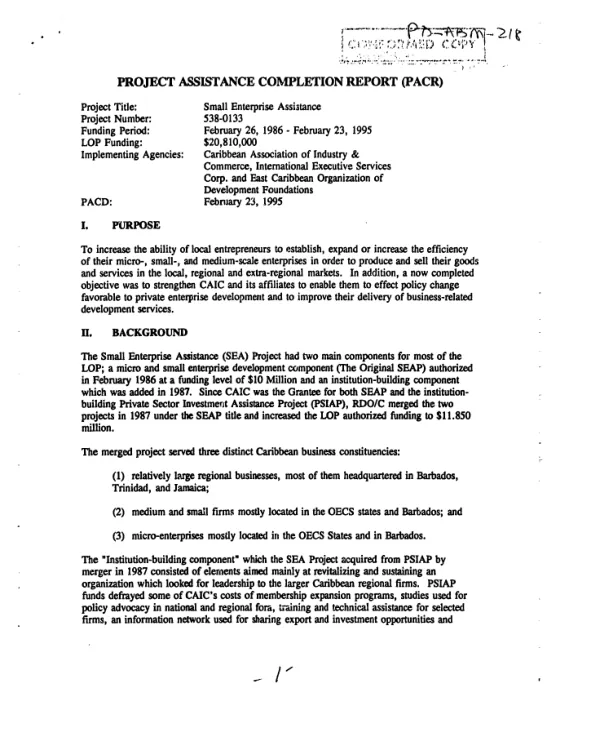
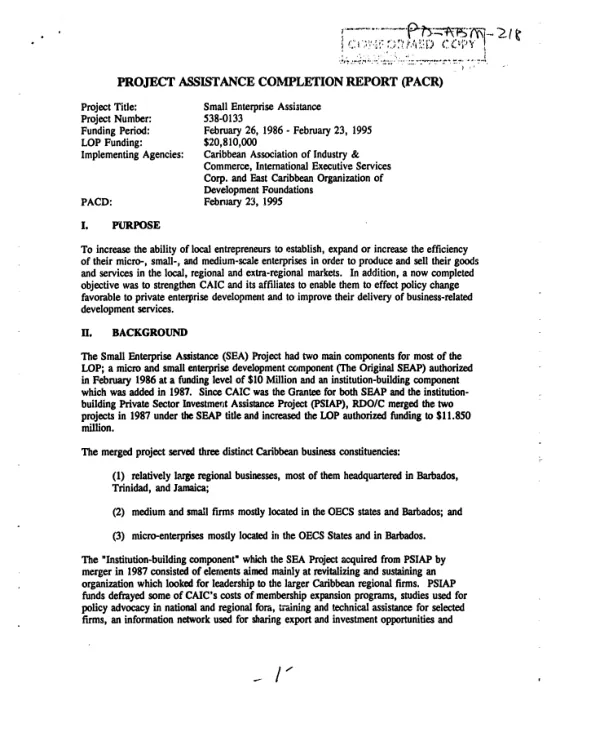
Project assistance completion report (PACR) : small enterprise assistance
PACR of a project (2/86-2/95) to increase the ability of local entrepreneurs in the Eastern Caribbean to establish new or strengthen their existing micro, small, and medium-scale enterprises.
1995
Sign in to readA free account is required to download.
Abstract
The project served as a major source of financial and technical assistance for the National Development Foundations (NDFs) and for Women in Development (WID) Ltd. and contributed significantly to their institutional development. Although the objective of financial sustainability for the NDFs was not attained, the foundations showed operational self-sufficiency levels of from 47% to 97.5%. WID Ltd., unfortunately, became ineligible for further USAID support after a 1992 audit. All in all, the project assisted with the start-up/expansion of more than 5,400 microbusinesses, delivered TA to more than 779 small and medium-sized enterprises (SMEs), and trained some 4,000 SME employees in technical and managerial skills. A 1987 evaluation found that the project's integrated approach of providing credit and TA made a significant impact in developing viable microenterprises. A later (1989) evaluation found that the Caribbean Association of Industry and Commerce (CAIC), the implementing institution, had become a leaner, better integrated, more cost-effective organization for delivering development services, and that its delivery of services to SMEs and its assistance to institutions supporting micro-businesses enhanced its reputation as a private sector representational institution and broadened its public support. Unfortunately, the withdrawal of USAID support saw the reversion of CAIC to strictly a membership services institution. The project had a significant impact on the expansion of the private sector in the region. The small and micro business sub-sectors are now solidly established as part of the private sector, and entrepreneurial spirit is in evidence across the region. The 1989 evaluation found that project-supported microenterprises were enjoying substantial increases in production and profits and that TA to small and medium size businesses had resulted in increased output and employment. Some 13,220 jobs (37% of them held by women) were created or sustained over the life of the project. The project also had a favorable impact on the emergence of institutional brokers of TA as well as a cadre of consultants able to provide quality services to SME firms. Lessons learned include the following. (1) In implementing a multi-component project that seeks to introduce new facilities or programs, activities should be sequenced rather than begun all at once. (2) Where a project is aiming to produce social interactions, the flow of resources should never be pre-conditioned on the achievement of that objective. (3) Firm-level programs should be carefully matched with their intended beneficiaries. (4) The need for TA should be carefully assessed to ensure that clients get the type of assistance they require.