USAID DEC
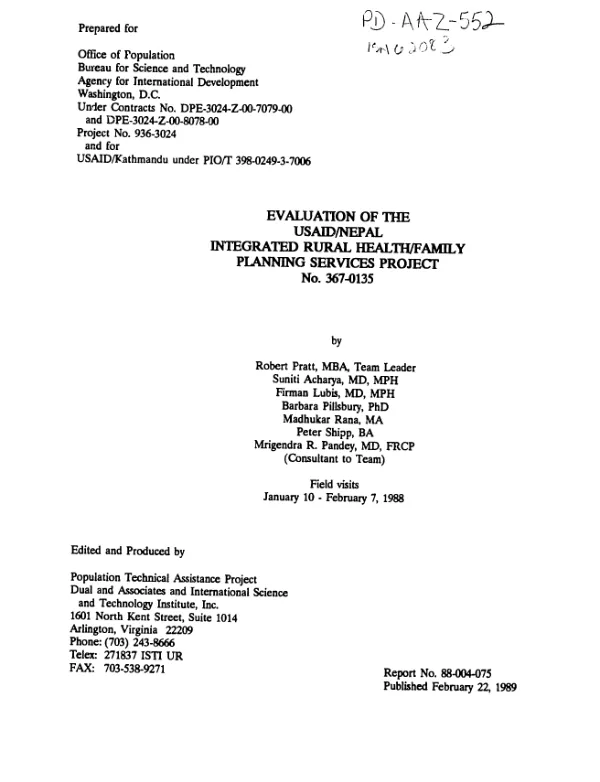
Evaluation of the USAID/Nepal integrated rural health/family planning services project, no. 367-0135
Sign inDUAL & ASSOCIATES, INC.
Evaluation of the USAID/Nepal integrated rural health/family planning services project, no. 367-0135
Final evaluation of a project to help Nepal"s Ministry of Health (MOH) to integrate its rural health and family planning services.
Pratt, Robert; Acharya, Suniti · 1989
Sign in to readA free account is required to download.
Abstract
External evaluation covers the period 1980-2/88, with emphasis on the post-1985 period. The project made very limited progress in improving the ability of the MOH to administer an integrated health system. As a result, the main recipient of project support, the Integrated Community Health Service Delivery Project (ICHSDP), was abandoned following a 1984 evaluation. Problems that marred ICHSDP performance are still very much in evidence, including overcentralized planning, poor financial and information management, and a personnel system that gives little or no support to field workers. The MOH"s Health Planning Division did not perform as hoped, and vertical health programs continued to do their own planning. The village health committee component made some progress, but committee functions need to be better defined. Field worker training proceeded fairly satisfactorily, but the drug stocking and distribution system has proved unworkable and should be abandoned. On the positive side, some integrated facilities appear to be functioning very well. In expanding family planning/health care services, the project had its greatest success in the area of voluntary surgical contraception (VSC). Quantitative goals were met, and VSC now accounts for 86% of all contraceptive use in Nepal. However, the number of VSC"s performed annually declined after 1985, and the adoption of temporary methods has lagged far behind VSC. The performance of family planning field workers was negatively affected by a lack of training, and personnel turnover was high due to extremely demanding outreach responsibilities. With regard to child survival interventions, the project primarily provided support to the expanded program of immunization and oral rehydration therapy. Some support was also provided in the areas of acute respiratory infection control, maternal health, and nutrition. After dropping the ICHSDP, the MOH developed a new policy aimed at integrating its vertical projects nationwide. While it is recommended that USAID/N support this new thrust, it is advised that efforts be concentrated in one region, rather than on trying to support implementation nationwide.
Related documents