USAID DEC
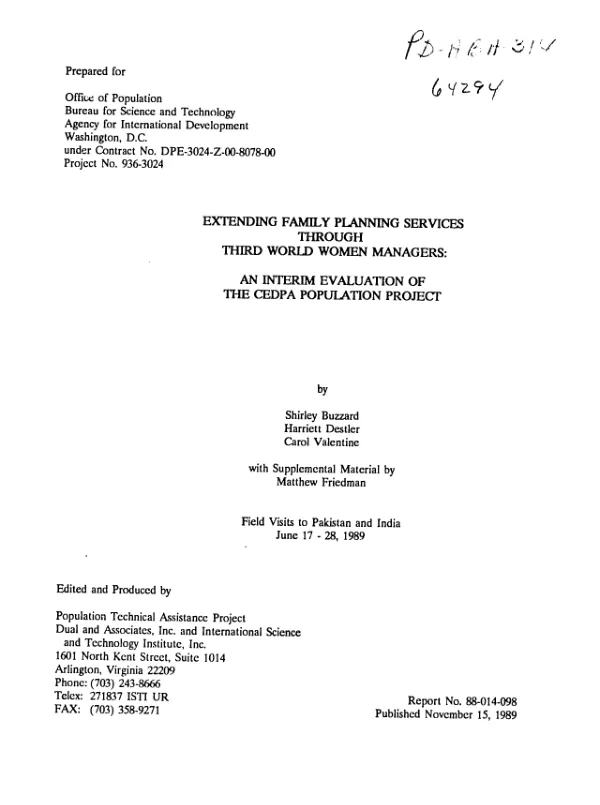
Extending family planning services through Third World women managers : an interim evaluation of the CEDPA population project
Sign inDUAL & ASSOCIATES, INC.
Extending family planning services through Third World women managers : an interim evaluation of the CEDPA population project
Evaluates cooperative agreement (9/85-8/90) between the S&T Bureau, Office of Population (S&T/POP) and the Centre for Development and Population Activities (CEDPA) for the purpose of delivering family planning (FP) services through subprojects (SP's) in 10 to 15 countries.
Buzzard, Shirley|Destler, Harriett|Valentine, Carol · 1989
Sign in to readA free account is required to download.
Abstract
CEDPA is known worldwide for its Women in Management and other training programs. Focusing on the 2,000 alumnae in the countries targeted by the project, CEDPA elicited SP concept papers from 110 people. Five proposal development workshops were held, and of the 55 attendees, 48 developed full proposals. After site visits and review by CEDPA and S&T/POP, 25 SP's were funded: 11 in Africa, 10 in Asia, 2 in Egypt, and 2 in Latin America. Five of the SP's have been cancelled: the two Nigeria SP's were turned over to Family Planning International Assistance as part of USAID/N's consolidation of centrally funded activities; the Haiti SP could not continue because of local political circumstances; and the collaborating Family Planning Associations in Sierra Leone and Uganda were unable to implement planned activities. In addition, the Sudan SP is being terminated because of a change in government. Nineteen SP's are ongoing in 11 countries. They are being implemented by women's organizations (local and national), welfare associations, an international PVO, health projects, a credit and a dairy cooperative, a women's small business association, educational institutions, and ministries of health. This interim evaluation found that CEDPA has met all targets and has pioneered in adding FP services to existing projects in other sectors such as small enterprise, health, and other for-profit ventures. Accomplishments: (1) The project model of including FP services in private sector programs has been successful. Over half the implementing organizations had no prior FP experience. (2) Some SP's achieved high use rates in communities in which FP had not been widely accepted. This is due to frequent follow-up visits by outreach workers and CEDPA's strong emphasis on informed choice. (3) Some SP's have influenced government policy. A Mali SP introduced a community-based distribution system which is the prototype for new Ministry of Health and USAID/M programs. In Nepal and Mali, it has been shown that FP services can be effectively delivered by nonmedical staff. Laws in Mali prohibiting the delivery of FP services by non-physicians are now under review. (4) CEDPA has been unusually successful in leveraging external resources for FP. (5) The project has had a positive impact on women - as designers and managers of FP projects, as outreach workers, and as clients. (Author abstract, modified)
Related documents