USAID DEC
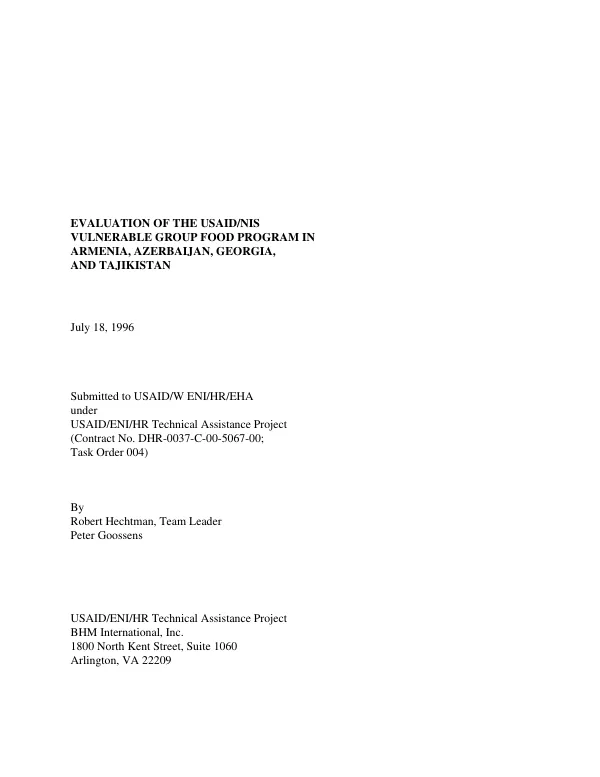
Evaluation of the USAID/NIS vulnerable group food program in Armenia, Azerbaijan, Georgia, and Tajikistan
Sign inBASIC HEALTH MANAGEMENT INTERNATIONAL (BHM)
Evaluation of the USAID/NIS vulnerable group food program in Armenia, Azerbaijan, Georgia, and Tajikistan
Evaluates USAID"s Vulnerable Group Food Program (VGFP) in three Caucasus countries (Armenia, Azerbaijan, and Georgia) and in Tajikistan.
Hechtman, Robert; Goossens, Peter · 1996
Sign in to readA free account is required to download.
Abstract
Despite the devastating consequences of recent political, economic, and environmental upheavals on social and family life in the four countries, the evaluation team was unable to detect signs of mass starvation or even malnourishment, and thus concludes that refugees and internally displaced peoples, along with the traditional vulnerable populations (the old, the sick, and large women-headed families) are making do. Most families appear healthy and well-nourished. A few reports indicate some signs of stunting but not the more serious wasting. Better housing, not more food, was the request the team heard most often on its field visits. How this can be is not clear; reasons advanced include higher disposable incomes (by a factor of over 10) than had previously been recognized, support provided by families/extended families and neighbors, remittances from abroad, and possibly the continuing sale of personal assets (although televisions, fine china, and crystal are evident among refugees" belongings). Nevertheless, and even though the absence of reliable baseline data makes it impossible to detect any advantage to programs such as the VGFP, the team believes that targeted supplemental food from USAID probably played a part in preventing acute malnutrition from taking hold in the Caucasus and considers the continuation of well-targeted supplemental feeding programs for entire families or isolated vulnerable population segments to be the best solution to providing effective food aid in all four countries. General recommendations are that: the total amount of targeted food aid be reduced through improved targeting; donors take every advantage of the income and expenditure studies underway in Armenia and Georgia and conduct similar studies in Azerbaijan and Tajikistan; and special care be taken not to allow such vulnerable populations as the hospitalized and elderly pensioners to slip through the targeted feeding network. The team endorses self-targeting feeding programs such as those run by the Salvation Army and the French PVO, AICF (Action Internationale Contre La Faim) as soup kitchens. It also supports the planned shift on the part of the PVO and development community from emergency or direct relief toward development assistance and job creation, and recommends the use of Title I local currency generations to support such development initiatives (such as has been a long-standing practice in Latin America). Of the three Caucasus republics, Azerbaijan deserves the greatest attention regarding continuation of USAID targeted food, given the plight of internally displaced persons and other vulnerable groups such as families of those killed in armed conflict. Georgia should be ranked somewhat lower than Azerbaijan and Armenia in the allocation of USAID targeted food. Despite higher government-to-government and remittance flows to Armenia than to Georgia, the team saw more self-help, better housing, and better access to energy by target populations in Georgia than in Armenia. With regard to Armenia, PVO and government authorities should assure targeting of all marginal populations, but other types of assistance should be increasingly phased in, with food assistance limited to groups that cannot be reached in other ways. Finally, with regard to Tajikistan, the team cautions against scaling down the food programs too quickly, at least until a better quantitative understanding of vulnerability in Tajikistan is gained.