USAID DEC
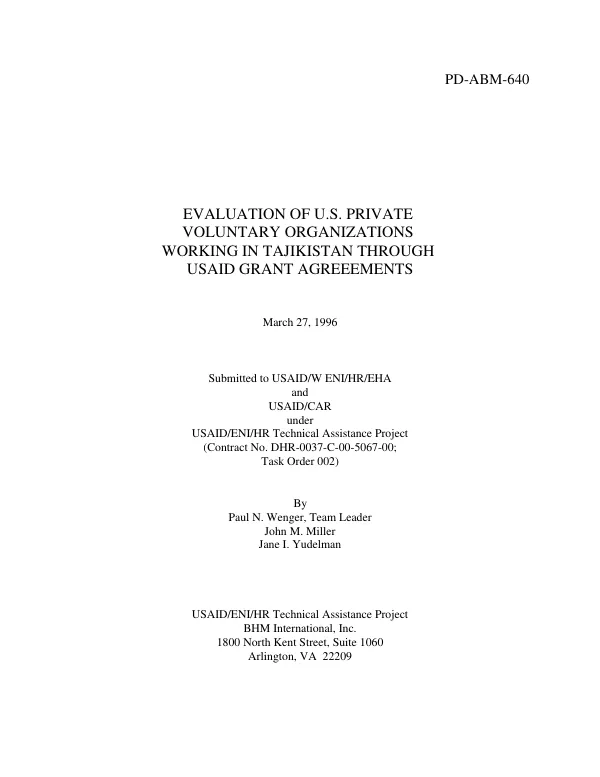
Evaluation of US private voluntary organizations working in Tajikistan through USAID grant agreements
Sign inBASIC HEALTH MANAGEMENT INTERNATIONAL (BHM)
Evaluation of US private voluntary organizations working in Tajikistan through USAID grant agreements
Evaluates the performance of five U.S.
Wenger, Paul N.|Miller, John N.|Yudelman, Jane I. · 1996
Sign in to readA free account is required to download.
Abstract
PVOs -- Aga Khan Foundation (AKF), CARE/US, International Rescue Committee (IRC), Relief International (RI), and Save the Children Federation (SCF) -- in providing humanitarian assistance and laying a foundation for economic development in Tajikistan from 1993 through 9/95. The USAID PVO program has contributed significantly to rehabilitating pockets in Afghanistan, mainly within Khatlon oblast. Collectively, the five organizations have begun to address a range of pressing needs in such areas as water and sanitation, health, food, housing, income, and capacity building; they have also worked with a variety of vulnerable groups, including internally displaced persons (IDPs), returning refugees, and women and children. The program has made the Tajik people feel that the rest of the world, including the United States, is aware of their plight and is willing to help. While, given the lack of baseline data, none of the 5 PVOs was able to assess its broader impact (e.g., on long-term health status), output has been impressive. AKF has fed 221,000 people and clothed 21,000 people; CARE has fed 250,000 people and provided a substantial number with medicines; IRC has provided 40,000 people with access to potable water and latrines; RI has restored health services for 260,000 people; and SCF has fed 27,000 housing reconstruction workers, provided 62,000 returned refugees and IDPs with shelter, and fed 71,000 school children. Only RI has had management problems requiring redress. USAID management is satisfactory, but could pay more attention to the PVOs and their programs and objectives. All the PVOs are capable of extending their programs into the development sphere, with most already beginning to do so. In addition, most of the PVOs have begun to provide training and TA to local NGOs (LNGOs) and/or community-based organizations (CBOs), which represent a potentially important development force in Tajikistan. The following are lessons learned. (1) U.S. PVOs were an effective means for delivering humanitarian assistance in the emergency period following the 1992-93 civil war in Tajikistan. However, Tajikistan will continue to require substantial levels of humanitarian and developmental assistance; given that the country is far distant and has weak infrastructure, this could be costly and difficult. (2) Short-term humanitarian assistance efforts should not be overly ambitious (e.g., seek to have a long-term impact on health status). Realistically, humanitarian efforts should seek to achieve immediate, measurable outputs (number of homes constructed, needy beneficiaries fed, etc.). Once longer-term development begins, attention can turn to longer-term goals and the development of baseline data needed to measure this type of progress. The need to work toward the development phase was absent in the original grant agreements and in subsequent implementation supervision by USAID. (3) AKF and SCF have improved the likelihood that their activities will be sustainable by involving LNGOs and CBOs early in their operations. USAID did not focus adequately on the potential for building sustainability through the involvement of these indigenous groups. (4) The lack of complete grant documentation and of progress reports to field representatives makes it extremely difficult to monitor project implementation and progress.