INTERNATIONAL SCIENCE AND TECHNOLOGY INSTITUTE, INC. (ISTI)
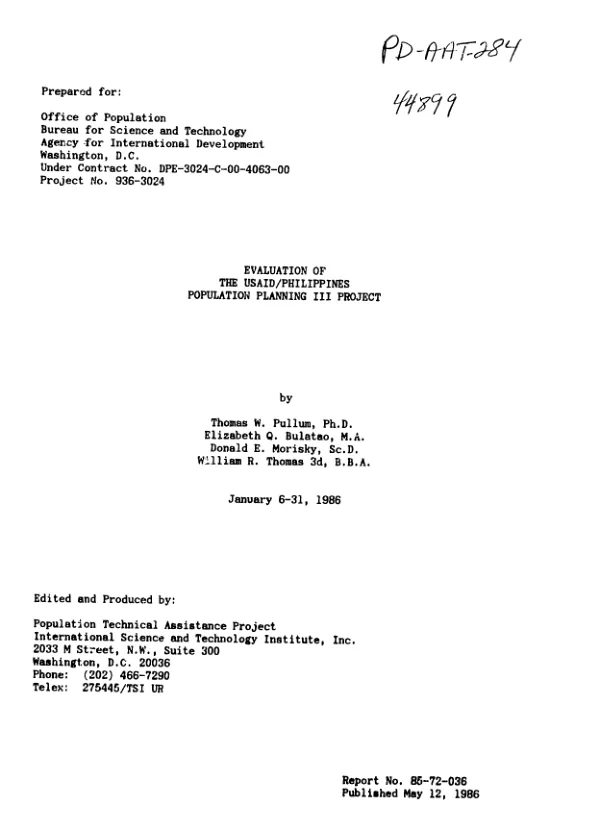
Evaluation of the USAID/Philippines population planning III project
Evaluates project in the Philippines to increase contraceptive prevalence and contraceptive use effectiveness among married couples of reproductive age.
Pullum, Thomas W.|Bulatao, Elizabeth Q. · 1986
Sign in to readA free account is required to download.
Abstract
External evaluation covers the period 8/80-1/86 and is based on site visits, document review, and interviews with personnel from USAID/P, the Government of the Philippines (GOP), nongovernmental agencies (NGO's), and other knowledgeable personnel. Project achievements - though reaching only about half the unrealistic targets set in the project design - are remarkable, and include an estimated annual increase of about 1% in prevalence of program methods and steady declines in the total fertility rate. Unfortunately, these accomplishments have been almost totally offset by social factors, e.g., declines in marriage age and duration of breastfeeding, and an unfavorable age structure. The project's outreach system is currently threatened by three proposed changes, each apparently motivated by cost and organizational considerations: (1) transfering outreach costs to local governments (which would likely eliminate outreach altogether in poorer areas); (2) a cost recovery scheme whereby users of condoms and pills must pay for supplies (cost recovery should be regarded as a long-term objective); and (3) integrating population activities with health and nutrition (which would inevitably decrease the amount of time fieldworkers could devote to family planning promotion). Project administration under the Philippine Commission on Population (POPCOM), while generally competent, is encumbered by that agency's dual responsibilities. POPCOM is responsible both for implementing project activities and for regulating and coordinating population activities in general; thus, it is often in competition with the NGO's it regulates. A related problem is that POPCOM has too much control over population research, which can lead to a misuse of POPCOM staff, bias against certain types of research, and conflicts of interest. A number of recommendations are made. Key among these is the need to give higher priority to increasing the demand for contraception (given the fact the desired family size in the Philippines remains at four children). This can be most effectively accomplished by highlighting the socioeconomic advantages of a lower population growth rate to GOP and local leaders. A.I.D and other donor agencies should be receptive to GOP proposals for a successor program. In the future, A.I.D. should play a more directive (i.e., less intrusive) role.