USAID DEC
Evaluation of the use and socio-economic profitability of imported commodities under the Madagascar agricultural rehabilitation support project-Dec. 23, 1987
Sign inUSAID. MISSION TO MADAGASCAR
Evaluation of the use and socio-economic profitability of imported commodities under the Madagascar agricultural rehabilitation support project-Dec. 23, 1987
Summarizes attached interim evaluation (XD-AAY-993-A) of a Commodity Import Program (CIP) to support the Malagasy agricultural sector by providing foreign exchange for imports of key agricultural and rural transportation inputs.
1970
Sign in to readA free account is required to download.
Abstract
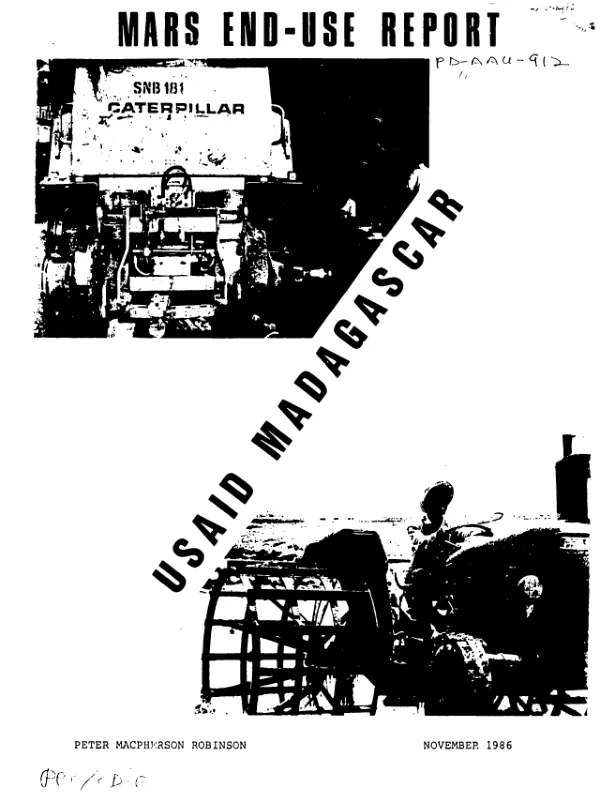
The evaluation covers the period FY85-12/87. The program has responded to a strong demand by importing 69 tractors, 100 light trucks, a bridge superstructure, and spare parts for road-building equipment. Except for the last truck shipment, which was adversely affected by the 8/87 currency devaluation, the equipment has been sold quickly. Two-thirds of the tractors were purchased for private use in direct agricultural production. Despite the 1987 fall in producer prices, the tractors have proved economically beneficial by expanding cultivated areas and improving yields. They have also increased job opportunities, particularly for the women and poor involved in weeding and rice transplanting. The major disadvantages have been the tractors" high costs and maintenance problems for farmers in remote areas. By providing a reliable supply of Caterpillar spare parts, the CIP has helped road-building firms, which employ 3,200 workers, to become more competitive in bids for large road or agricultural development projects. The agro-industry, mining, and industrial fishing sectors have also benefited; many beneficiaries would have closed operations without this help. The light trucks were all sold to the private sector and the vast majority are used for service industries (i.e., commercial transportation of goods to and from rural areas). The trucks are well-liked, although spare parts are difficult and expensive to acquire. Finally, the bridge constructed under the program facilitates the transportation of inputs, produce, and agricultural workers in 4 districts. The program has revealed that there exists a significant unmet demand for commercial vehicles in Madagascar and that a CIP can help lessen the foreign exchange bottleneck which keeps that demand from being met.
Related documents
Documents in this collection
 1987
1987USAID DEC
Evaluation of the use and socio-economic profitability of imported commodities under the MARS project (Madagascar agricultural rehabilitation support)
Open record 1987
1987USAID DEC