INTERNATIONAL SCIENCE AND TECHNOLOGY INSTITUTE, INC. (ISTI)
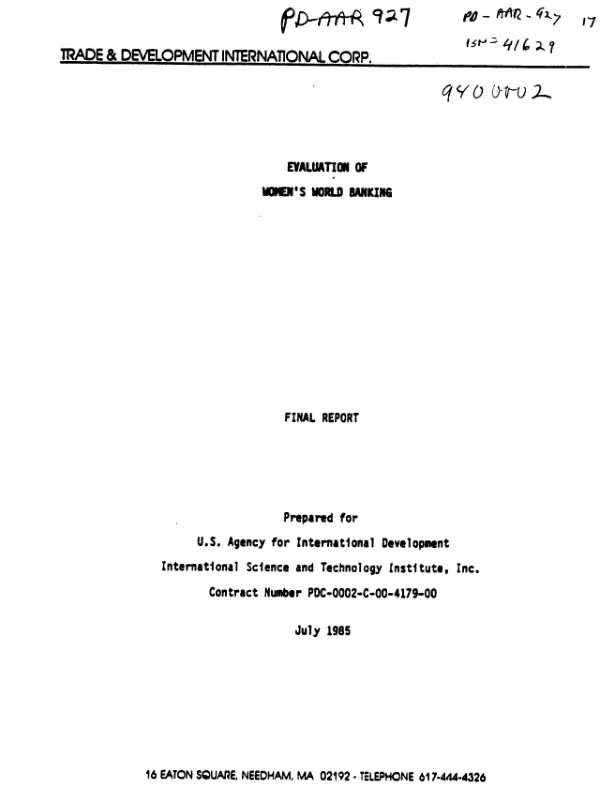
Evaluation of women's world banking : final report
Evaluates project to help Women's World Banking (WWB) provide credit and TA to low-income LDC female entrepreneurs.
1985
Sign in to readA free account is required to download.
Abstract
Special evaluation covers the period 1982-7/85 and is based on document review, site visits, and interviews with WWB staff and board members. The most valuable service that WWB provides is aiding national affiliates in establishing themselves - 22 affiliates are legally chartered (not all in LDC's) and another 18 are being formed. Four affiliates - in Colombia, the Dominican Republic, Haiti, and India - are providing loans to entrepreneurs (either directly or through loan guarantees to local banks); the first three named provide TA as well (both lending procedures and level and nature of TA vary among affiliates). To date, WWB loan guarantees of $175,000 have resulted in 626 loans totaling $243,000, which have in turn increased clients' profits some 40% per year and have led to the creation of some 730 new jobs. Overall, a 268% annual return on WWB guarantees is predicted. The loans have not yet, however, enabled a significant number of clients to become independent banking customers. WWB headquarters staff are devoted and hard-working, but too much responsibility falls on the president; management chain of command, staff specialists, and financial and legal control over affiliates (except through loan agreements) are lacking. WWB also notably lacks a satisfactory system for communicating with affiliates; workshops have been the best single communicating device to date. On the other hand, WWB's prospects for financial self-sufficiency look very good indeed if a fee-for-service policy is adopted. WWB's Dominican Republic affiliate is close to the WWB ideal; it is financially self-sufficient and able to remain so. However, its two greatest problems are lack of professional staff and of bank liquidity. The Colombian affiliate, also very active, focuses on lending to solidarity groups of market women (two programs for microenterprise clients are being phased out). This strategy - specialized, training-intensive intervention with just one (traditionally poor-risk) type of client - can be dangerous over the long-run. In Haiti, the WWB loan program is small and fundraising difficult. A key recommendation is that WWB suspend its plans to provide marketing services to loan recipients.
![Evaluation of project impact : ACEP [Agence de Credit pour l"Enterprise Privee (Agency for Private Enterprise)] component of the community enterprise development project](https://covers.devme.ai/gen/38010.webp)