RONCO CONSULTING CORP.
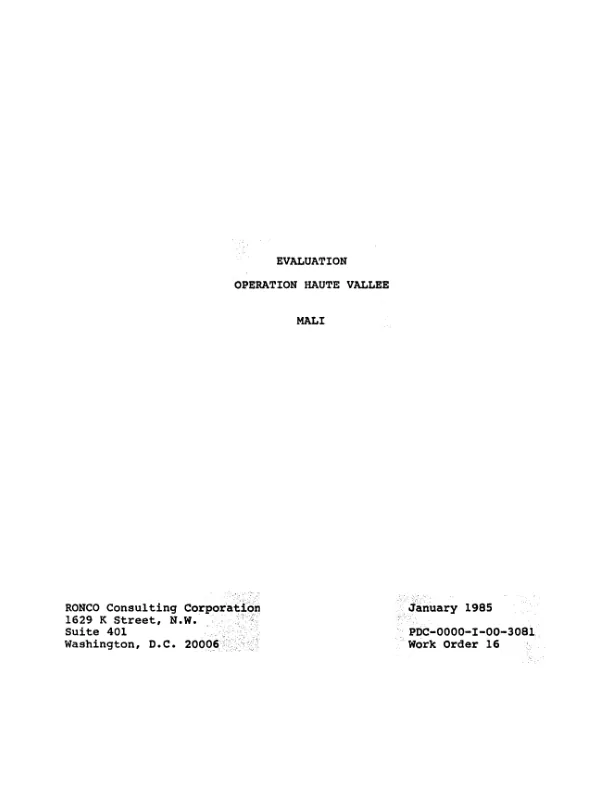
Evaluation : Operation Haute Vallee, Mali
Evaluates integrated rural development project in the Upper Niger River Valley area administered by the Government of Mali's (GOM's) Operation Haute Vallee (OHV).
1984
Sign in to readA free account is required to download.
Abstract
Joint U.S./GOM end-of-project evaluation covers the period 1981-8/84, emphasizing progress since a 7/83 redesign, and is based on document review, site visits, and interviews. As the application of A.I.D.'s new Sahel financial certification requirement interrupted disbursements for 6-12 months or more, some project components are significantly behind schedule, and some GOM agencies have yet to resume project activities. Nevertheless, since the project redesign, which stressed strengthening of OHV, significant progress has been made in improving OHV management, integrating poorly-used TA more thoroughly into the system, and initiating medium-term planning. The credit system is being computerized and is reasonably efficient (the number of village groups receiving credit is on the rise) and should be tested with increased funds during the next agricultural campaign. OHV financial controls are being exercised and procurement controls improved. Marketing continues to operate fairly well, and some improvements have been made in vehicle maintenance. Road construction, while behind, is under budget with better than expected standards. Problems remain, however, due mostly to OHV's preeminent concern over maintaining cotton revenues, which provide most of its operating costs. On-farm research has not improved; agricultural extension, incompetent and unsupervised, has had little impact; the credit system is available almost solely to cotton producers; and agricultural technology (except for cotton production and some attempts to introduce a new maize variety) has stagnated, as have functional literacy efforts - the latter crucial to the OHV group lending approach. Also, the GOM continues to view Bancoumana rice irrigation as part of the project, although A.I.D. deleted this component in 7/83. As a Phase II cannot yet be recommended, extension to 6/86 is suggested. OHV still needs improved planning, training, and personnel management systems and changes in organizational structure; most importantly, OHV needs willingness to focus on whole-farm systems, not just cotton.