MANAGEMENT SCIENCES FOR HEALTH (MSH)
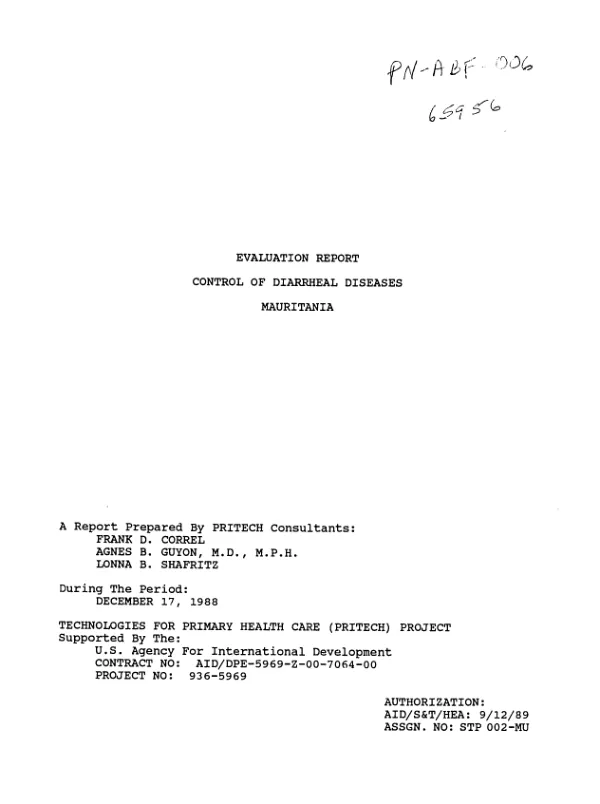
Evaluation report : control of diarrheal diseases, Mauritania
Evaluates the Government of Mauritania's diarrheal disease control program, which is receiving technical assistance from A.I.D.
Correl, Frank D.|Guyon, Agnes B.|Shafritz, Lonna B. · 1989
Sign in to readA free account is required to download.
Abstract
under project 9365969 (PRITECH project). External evaluation covers the period 1983-12/88. After five years, the program is still in an early operational stage, and has far to go before it will have a significant impact on the health of the target population. So far, it has established a conceptual framework and a national coordinator's office which performs planning and organization work as well as fundraising. Coordination at the regional level exists in principle. Educational and informational materials, including booklets, flyers, and posters, have been produced and distributed to health facilities at regional and departmental levels for use in educating mothers in oral rehydration therapy. Judging from the observations of the evaluation team, few mothers have the knowledge to give their children appropriate treatment of diarrhea, and few health workers treat children with diarrhea according to WHO protocols. There are chronic shortages of basic materials, particularly of oral rehydration salts, and there is considerable recourse to inappropriate drugs. The modest level of achievement is primarily due to inadequate coordination of the various program components. As a result, mothers and health workers alike receive mixed and often poorly timed messages unreinforced by necessary supportive materials. Additional problems include: (1) insufficient program monitoring and evaluation due to internal organizational conflicts, a chronic lack of financial and material resources, and a lack of adequate information; and (2) the program's total dependence on outside support and uncertain funding availabilities. The PRITECH project has played a key role in providing TA for management of the CCD program. According to the CCD Coordinator, without future assistance from PRITECH, the program may have to be cut back by half.