MANAGEMENT SCIENCES FOR HEALTH (MSH)
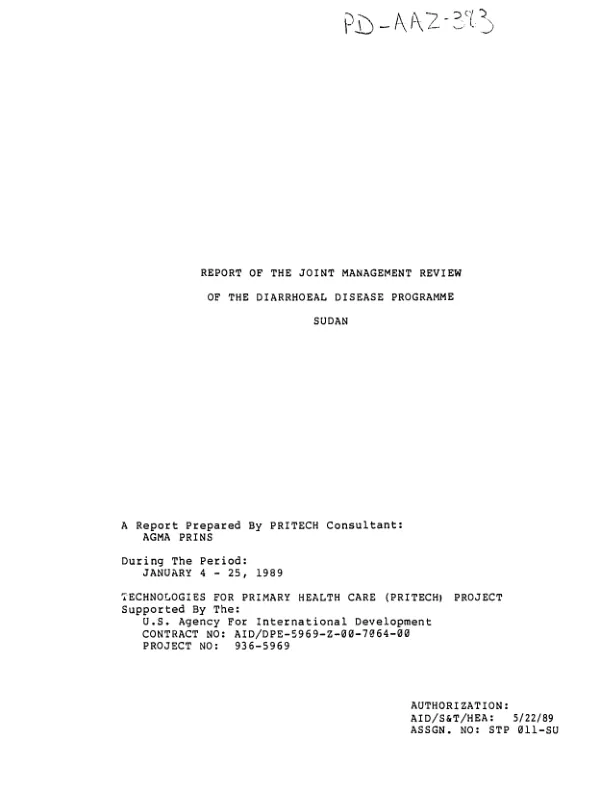
Report of the joint management review of the diarrhoeal disease programme, Sudan
Evaluates Sudan's program for Control of Diarrheal Diseases (CDD).
Prins, Agma · 1989
Sign in to readA free account is required to download.
Abstract
Evaluation covers the period through 1/89. CDD is a well-managed, balanced, and thoughtfully implemented program, which has achieved remarkable progress in its 3 years of existence despite political, economic, and logistic constraints. It has created an effective central unit able to develop relevant policies, training, and health educational materials. The policy of decentralization of authority and responsibility for CCD implementation and training has resulted in effective programs in most regions of Sudan. Major success has been achieved in training, especially in management training of senior staff and in paramedical, nurse, and community leader training in diarrhea case management. However, performance in training of physicians and pharmacists has been poor, reflecting some resistance by these professions to new simple techniques plus difficulties in reaching them with training courses and materials. CDD has not yet developed a training program entirely suitable for these professions. Oral rehydration therapy (ORT) is now widely available, knowledge of and acceptance of its use is increasing among the public, and staff trained in its use are available in many health facilities. Efforts to ensure that one-litre measures are universally available have met with some success. Although ORT is widely available, the system is not dependable or wholly effective, resulting in irregular and uncertain supplies in most areas. The main problem appears to lie in the national medical supplies system, but some corrective action will probably be needed from CDD staff if an effective diarrhea treatment service is to be maintained. Success has been achieved in ensuring that all organizations concerned with health in Sudan are following nationally accepted guidelines. Much valuable experience has been gained from the efforts of small, local organizations and communities to develop CDD activities. Central CDD staff have emphasised health education conducted during diarrhea consultations at health facilities and have successfully produced numerous print and visual materials to support this effort. Other communications channels, especially at the community level have remained largely unused except for many scattered experimental activities originating from regional and local initiatives. CDD has developed at the central and regional levels as a largely vertical program, with relatively little integration with other primary health care (PHC) activities. The problem lies far more with the poor development of PHC than with any isolationist activities by CDD. Data collection and analysis and its use nationally or locally for planning is not currently effective. As a result, it is difficult yet to measure programme impact. Problems in surveillance and supervision, which are both difficult elements in establishing a CDD programme in a country as vast as Sudan, with its communication difficulties, have not yet been adequately resolved.
Related documents
![Mid-term evaluation report for child survival VII : [contract] # PDC-0500-A-00-1007-00 -- Nicaragua](https://covers.devme.ai/gen/5805.webp)
![Mid-term evaluation report for child survival VII : [contract] # PDC-0500-A-00-1007-00 -- Nicaragua](https://covers.devme.ai/gen/42566.webp)