USAID DEC
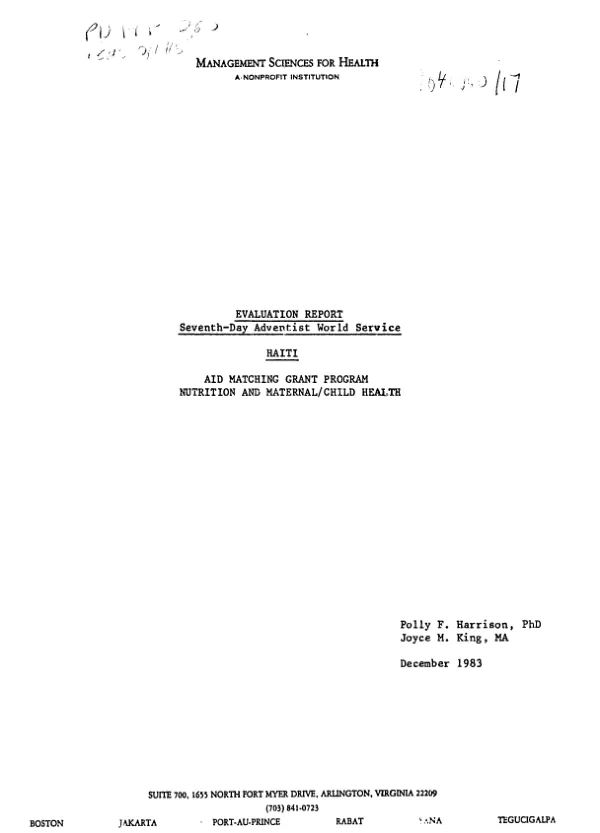
Evaluation report, Seventh-Day Adventist World Service : Haiti, AID matching grant program, nutrition and maternal/child health
Sign inSEVENTH DAY ADVENTIST WORLD SERVICE, INC.
Evaluation report, Seventh-Day Adventist World Service : Haiti, AID matching grant program, nutrition and maternal/child health
Evaluates project to support Seventh Day Adventist World Service's (SAWS) maternal/child feeding and other nutrition and health improvement activities in 10 target areas of Haiti.
Harrison, Polly F.|King, Joyce M. · 1983
Sign in to readA free account is required to download.
Abstract
Special evaluation covers the period 6/81-11/83 and is based on site visits and interviews with SAWS and nutrition center personnel and with beneficiaries and community leaders. Compared with similar programs in Haiti, the SAWS program has been unusually successful in helping children achieve and maintain weight gains - it has saved a number of severely malnourished children from death and is even producing impressive weight gains in the difficult one-to-two-year-old group. Although the program is still too young to assess the durability of these improvements or the possibility of spread effects, attendance at follow-up weighing is quite good at 72%. The food provided by SAWS is high in both nutritional and economic value, compared to other programs, but without creating excessive dependency and at a satisfactory cost-benefit ratio. Program impact has varied among nutrition centers, and attendance is clearly correlated with nutritional improvement. In terms of quantitative outputs, the project is on target in establishing nutrition centers, ahead in training health workers and installing kitchen gardens, but behind in self-help projects (SAWS has serious doubts about proliferating skills for which there is little or no identified market) and in numbers of children completing the program and being weighed monthly. Nutrition/health education has been deficient, especially in priority areas, largely because of limitations in supervision (at the lower level) and in staff training (which tends to be unfocused, overly inclusive, and nonexperiental). Clinic management and program evaluation are also weak. The overall success of the SAWS program can be ascribed to the PVO's flexibility, practical orientation, well-functioning logistic and financial systems, and the quality and commitment of its staff. Key recommendations are to: (1) make growth surveillance the centerpiece of the program, and limit other activities to food supplementation, nutrition/health education, and a modest home gardening effort; and (2) provide SAWS with TA to improve its supervision, education (of staff and mothers), and evaluation capabilities.